
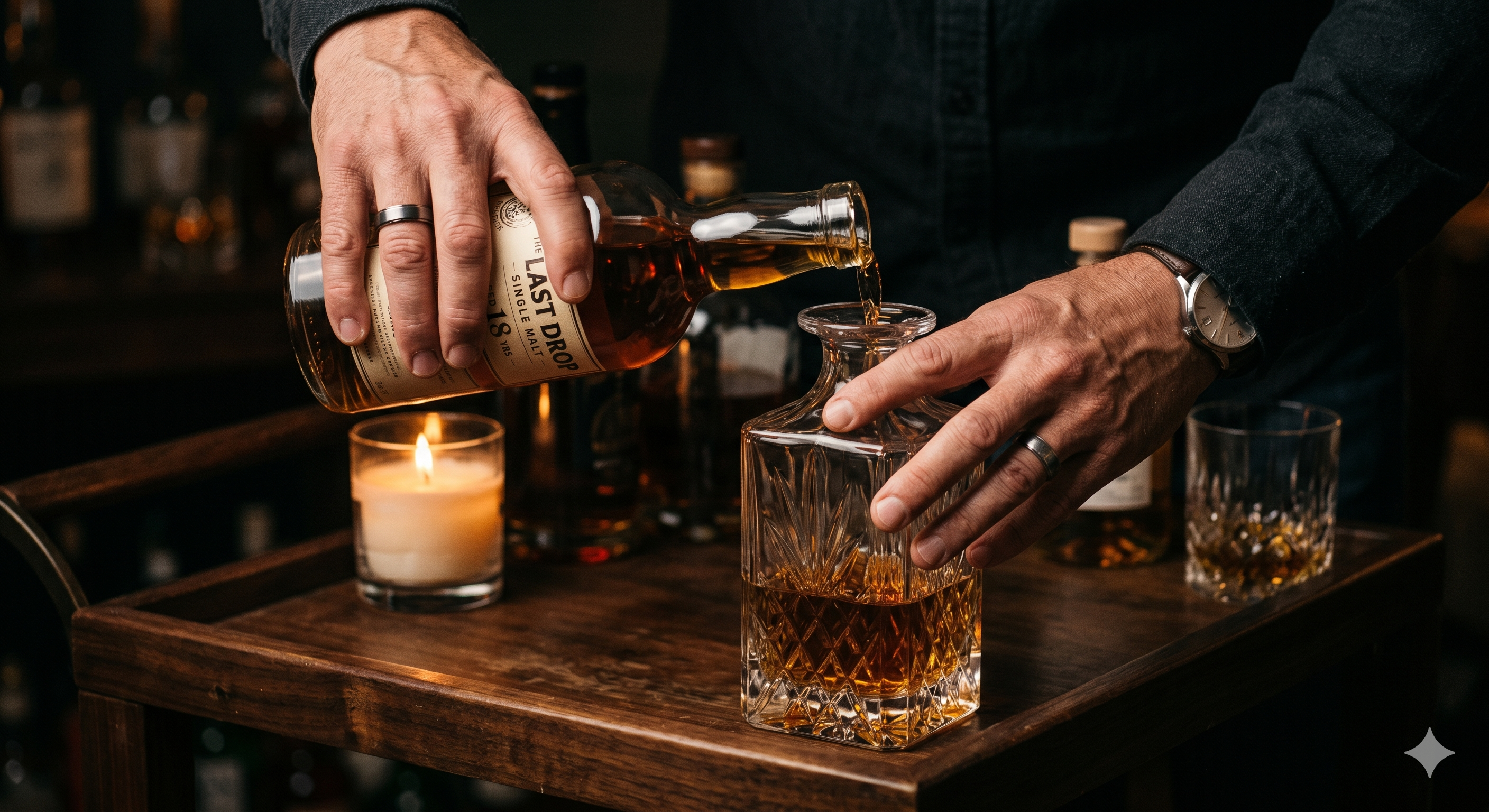
There is a bottle on a shelf somewhere that contains the last quarter-inch of a birthday bourbon, the final pour of a wedding Scotch, and the remnants of the best Irish whiskey a man ever tasted. Nobody blended it in a distillery. No master blender approved it. The person who made it needed only a good decanter, a little patience, and the habit of never quite finishing a bottle without asking: does this belong?
That bottle is an infinity bottle, and once you understand what it actually is, not a storage container or a party trick, but a living record of your whiskey journey, you will not be able to look at an empty bottle the same way again.
This guide covers everything you need to start your own: what goes in, what stays out, how the blend evolves month by month, and why the vessel you choose matters more than most people realise.
What an Infinity Bottle Actually Is
The concept is deceptively simple. Every time you finish a whiskey, you pour the last one or two ounces into a single dedicated vessel rather than letting it disappear. Over months and years, that vessel becomes a continuously evolving blend, part bourbon, part single malt, part rye, with a flavour profile that no distillery could replicate because it belongs entirely to you.

The tradition has roots in the solera system used in sherry production, where older liquid is perpetually blended with younger additions to create consistent complexity over time. Applied to whiskey, it borrows that principle and strips away the formality. There are no rules about proportions, no pressure to create a technically perfect blend. As one enthusiast described it: "It's supposed to be fun, not a master blend. I keep mine in a decanter. It looks nice and cool."
That informality is precisely the point. The infinity bottle celebrates personal taste over objective quality. It is the antithesis of the locked cabinet and the unopened collector's bottle. It is whiskey you actually drink, poured into something worth looking at, added to over time until it becomes something entirely your own. If you are weighing up whether a decanter changes the taste of whiskey at all, the infinity bottle answers that question differently: what changes the taste is the accumulation of your own choices over time.
Why the Blend Gets Better Every Month
This is not marketing language. It is chemistry and psychology working in the same direction.
On the chemistry side, blending different whiskeys creates what distillers call integration. Congeners and esters from different mash bills, ages, and cask types begin to interact. Sharp edges soften. A bourbon's high corn sweetness can round out the smoke in an Islay Scotch if managed carefully. A rye's spice can lift a flat, over-oaked expression. None of these interactions happen overnight, but after six to eight weeks with each new addition, the liquid has genuinely changed.
On the psychology side, each pour you take from an infinity bottle carries narrative weight. You are not drinking a product. You are drinking a record of decisions you made, moments you marked, and bottles that mattered enough to preserve. Research into whiskey consumer behaviour consistently finds that ritual transforms consumption into ceremony. An infinity bottle is the fullest expression of that principle: the decanting is deliberate, the addition is considered, and the tasting tells you something about how far the blend has come.
One community member who had maintained his bottle for over four years described it as "a living history of my whiskey journey, a blend of over 60 bottles." That is not sentimentality. That is the product actually getting more complex, more layered, and more personal with every passing month. This is also why choosing the right vessel from the start matters. You can read more about what makes a good whiskey decanter before you commit to one.
How to Start: The First Pour Matters Most
Most people overthink the beginning. The right starting point is a whiskey you genuinely enjoy, something balanced, approachable, and without extreme characteristics that will permanently dominate the blend. A well-rounded bourbon, a lightly sherried Speyside, or a clean blended Scotch all work well as a foundation.
Start with two to four ounces in a clean, lead-free glass decanter. Do not begin with something you dislike or something with a flaw you are hoping the blend will correct. Whatever is in the bottle first sets the direction. Weaknesses accumulate rather than cancel out.

Fill to roughly fifty percent capacity before your first serious tasting. Below that threshold, the headspace is too large, individual additions dominate too heavily, and you cannot yet taste the integration. Once you reach the halfway mark, pour a small measure, nose it properly, take a sip, and decide whether the blend is heading somewhere interesting. You are not judging it against any external standard. You are calibrating your own palate so you know what to add next.
From here, the practice becomes a monthly habit rather than a project. Finish a bottle, add the last ounce or two, stir gently, wait a few weeks, and taste again. Keep notes if you enjoy the process. Photograph the colour against a light at the three-month, six-month, and twelve-month marks. You will be surprised how visibly it changes. One thing worth understanding early: how long whiskey can actually be stored in a decanter affects how you manage your infinity bottle, particularly around headspace and oxidation.
What to Add and What to Keep Out
The most consistent advice from the infinity bottle community is also the most important: add only what you enjoy drinking on its own. If a whiskey is forgettable, its contribution to the blend will be forgettable too. If it has a specific flaw, excessive bitterness, artificial vanilla, a metallic finish, that flaw will persist long after the bottle is gone.
Peated whiskey deserves special caution. Islay Scotch, heavily peated Japanese expressions, and any spirit with significant medicinal or bonfire smoke will permanently define the character of the blend from the first addition. That is not necessarily a bad outcome if smoke is what you want, but it cannot be undone. Many enthusiasts maintain a separate infinity bottle exclusively for peated whiskeys to preserve the integrity of their main blend.
Beyond peat, the blend rewards variety. Bourbon adds caramel sweetness and vanilla. Rye contributes spice and backbone. Irish whiskey brings lightness and fruit. Sherry-cask Scotch delivers dried fruit and nuttiness. American single malts add unexpected complexity. The most satisfying infinity bottles tend to span categories rather than staying rigidly within one.
One practical rule: if you finish a bottle and genuinely hesitate before adding it, trust the hesitation. The blend will keep evolving, and there will be better additions. The gatekeeper instinct is part of what makes the practice meaningful. If you are ever curious whether your base whiskey alone would behave differently outside the bottle, this guide on whiskey decanter versus original bottle is worth a read.
Choosing the Right Decanter: Why It Is Not Just Aesthetic
The vessel is not a footnote. It is the centrepiece of the entire practice.
A good infinity bottle decanter needs three things that most decorative decanters do not deliver: a seal that actually functions, a capacity that allows proper headspace management, and materials that will not leach anything into liquid that may sit in them for years. Lead-free glass is non-negotiable, not as a marketing claim, but as basic safety hygiene when you are pouring whiskey into the same vessel repeatedly over an extended period.
On seal quality: enthusiast communities consistently flag this as the most common failure point in infinity bottle decanters. A loose or poorly fitted stopper accelerates oxidation, flattens aromatics, and can ruin months of careful blending. If you are asking whether whiskey decanters need to be airtight, the short answer for an infinity bottle is: yes, more than almost any other use case.
On capacity: most infinity bottle practitioners work within a 750ml to one-litre range. Too small and you are constantly managing headspace, which requires either topping up frequently or accepting more rapid oxidation. Too large and individual additions feel lost rather than integrated.
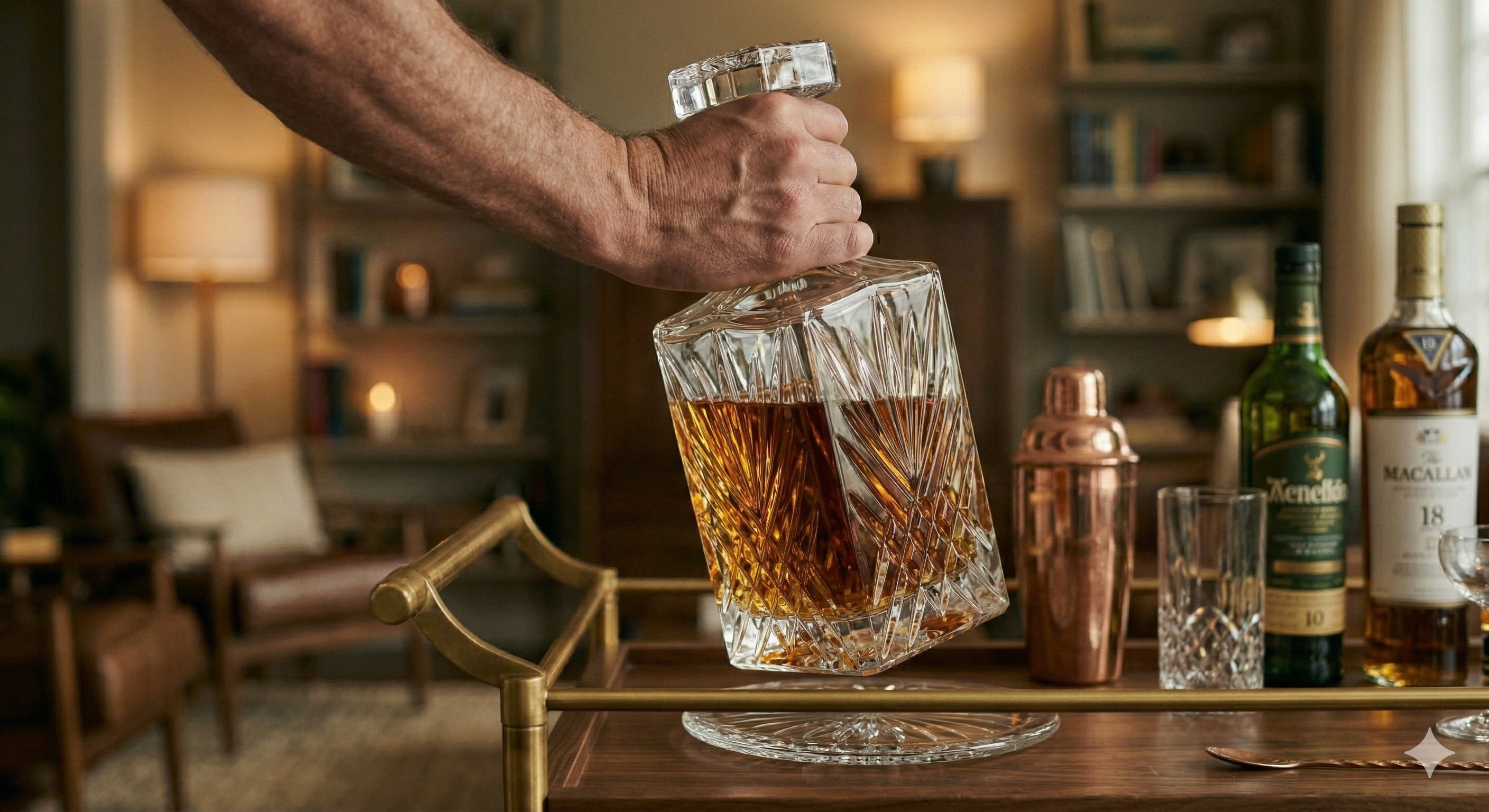
On aesthetics: this matters too, and it is not a shallow concern. An infinity bottle that sits on your bar cart and draws conversation is part of the ritual. The act of pouring from something beautiful, something weighted, considered, and visibly premium, changes the experience of the pour itself. Consumer psychology research consistently confirms that presentation influences perceived quality, and nowhere is that more true than in a practice built around deliberate, sensory engagement.
Understanding the difference between a cheap and a premium whiskey decanter matters more for an infinity bottle than for any other use. The vessel you choose for this practice will be on your bar for years. It needs to earn its place.
If you are deciding between shapes, the decanter shapes guide covers the practical differences between globe, diamond, twisted, and fashion styles so you can choose the right form for how you pour and display.
The Ritual Around the Pour
The infinity bottle is also an invitation to be more intentional about how you drink. Most whiskey is poured and consumed without ceremony. The infinity bottle asks you to slow down, not because slowing down is virtuous, but because the blend rewards attention.
When you add a new whiskey, take a moment to nose the decanter before adding and then again after. The shift tells you something immediate about what the new addition has contributed. When you pour a dram for yourself or a guest, observe the colour against the light. The hue deepens and grows more complex over time, and that visual cue is part of the pleasure.
Some enthusiasts keep a simple journal, a bottle name, a date, and a note on how the blend tasted afterward. Others photograph their decanter at milestones. The documentation does not need to be elaborate to add meaning. Even a few lines in a notebook transforms the practice from habit into record-keeping, from hobby into personal history.
When you serve from an infinity bottle to guests, you are offering them something no one else in the world has. That framing changes the conversation around the pour entirely. For anyone building out the space around that bottle, the full guide to setting up a home bar cart covers how to display and arrange everything properly.
Frequently Asked Questions
What whiskeys should I put in an infinity bottle?
Add only whiskeys you genuinely enjoy drinking on their own. A well-rounded bourbon, a lightly sherried Speyside, or a clean Irish whiskey make strong starting points. Avoid peated expressions unless you want smoke to define the blend permanently, and avoid anything with obvious flaws. Those flaws will persist. If you are unsure whether the decanter itself will change the flavour of individual additions, the answer is: minimally, and mostly for the better with proper seal quality.
How long does an infinity bottle take to develop?
Most enthusiasts notice meaningful integration after six to eight weeks from a new addition. Real complexity tends to emerge between three and six months, once several whiskeys have had time to interact. The blend keeps evolving as long as you keep adding to it. Experienced practitioners describe bottles they have maintained for three to five years as genuinely different from what they started with. Managing oxidation is key to that longevity, which is why understanding how long whiskey lasts in a decanter gives you the right framework for topping up and headspace management.
Does an infinity bottle improve with age?
Yes, within the bottle, but not indefinitely and not without management. Proper headspace control, a well-sealed lead-free decanter, and thoughtful additions all contribute to ongoing improvement. The blend does not age the way cask whiskey does. It integrates rather than matures. That means quality of additions matters as much as time. A well-curated infinity bottle at eighteen months will typically offer more complexity and character than a poorly managed one at five years.
Where Legends Unwind
The infinity bottle is the most personal whiskey project most enthusiasts will ever build. It requires no expertise, no formal training, and no expensive equipment. Only curiosity, a decent palate, and the discipline to save the last pour rather than drain it. What it returns, over months and years, is something no shelf of bottles can offer: a single vessel that holds the full arc of your whiskey education.
The decanter you choose for it will sit on your bar cart for years. It needs to be lead-free, properly sealed, and built for the long game. Because the blend inside it is being built for the long game too.
Start small. Add slowly. Taste often. Let the blend tell you where it wants to go.
Ready to build yours?
Every infinity bottle needs a home worth the blend inside it. Hydro Gizmos decanters are lead-free, properly sealed, and designed to earn a permanent place on your bar cart, not just as a vessel, but as the centrepiece of a ritual you will build for years.
Explore the full decanter collection at Hydro Gizmos.


Share:
7 Things You Can Do With a Whiskey Decanter That Most People Never Try
The Cheap Whiskey Trick: Why a $20 Bottle in a Decanter Beats a $60 Bottle on the Table