

You poured a glass from your decanter after it had been sitting for a few weeks. The whiskey looked the same. But the nose was flatter than you remembered, and the finish felt shorter. You topped it up from the bottle and within a few days it tasted right again.
That is oxidation at work, and in almost every case, a loose stopper is the cause. It is not dramatic. The whiskey does not go bad overnight. It just quietly loses what made it worth buying.
This post explains exactly what airtight means in the context of a whiskey decanter, how the three main stopper types compare, and what to check on your current decanter right now.
The Direct Answer
Yes, whiskey decanters need to be as airtight as possible. A loose or poorly fitted stopper allows oxygen in continuously, which accelerates oxidation, causes alcohol to evaporate faster than water, and strips the whiskey of its nose and flavor balance over weeks. A well-machined, precision-fit stopper slows this process significantly and keeps your whiskey tasting as it should.
What you need to know:
-
Airtight matters most for storage: The longer whiskey sits in a decanter, the more a poor seal costs you in flavor and proof
-
Glass-on-glass stoppers vary widely: A hand-ground, precision-lapped stopper creates a near-hermetic seal; a machine-pressed one often does not
-
Oxidation is real but slow: Whiskey oxidizes far more slowly than wine due to its high alcohol content, but a bad seal speeds the process significantly
-
The tilt test reveals everything: A tight stopper should show zero seepage when the decanter is gently tilted over a sink
-
Lead-free matters too: An airtight seal on a lead crystal decanter still poses health risks with extended spirit contact
-
Three stopper types exist: Glass-on-glass, plastic-gasketed, and cork, each with different seal performance and aesthetics
-
Headspace amplifies the problem: The more air inside the decanter above the whiskey, the faster oxidation occurs regardless of stopper quality
Why an Airtight Seal Is Not Optional
An airtight seal does one job: it limits how much oxygen gets into contact with your whiskey between pours.
Whiskey is a stable spirit. Unlike wine, its high alcohol content, typically between 40% and 50% ABV, means it does not spoil quickly on air contact. But stability is not immunity. Over days and weeks, oxygen slowly breaks down aromatic compounds, dulls complex flavor notes, and causes alcohol to evaporate faster than water, which lowers the proof and throws off the balance of the pour.
The stopper is the only thing standing between your whiskey and that process. A factory-sealed bottle uses a metal screw cap or a compressed cork that creates an almost completely airtight environment. A decorative glass stopper, depending on how precisely it was made, offers somewhere between excellent protection and almost none at all.
In consumer research reviewed by our team, poor stopper seals were the single most cited functional complaint about whiskey decanters, appearing across more than eleven independent sources. One frequently quoted comment put it plainly: "A majority of decanters do not have a good seal on the stopper. Your whiskey will oxidize faster than if it were in a bottle."
That is the real-world consequence of buying a decanter based on looks alone without checking how the stopper is made.
To understand how how long whiskey stays good in a decanter relates directly to stopper quality, that post walks through the full storage timeline in detail.
The Three Stopper Types and How They Actually Perform
Not all decanters seal the same way. Understanding the difference saves you from a purchase you will regret.
Glass-on-glass stoppers are the standard on premium decanters and the most visually appealing option. Their performance, however, depends entirely on manufacturing precision. When a stopper has been hand-ground and lapped into the neck of the decanter, the fit creates a near-hermetic seal that performs well for weeks to months of storage. When the stopper is machine-pressed with a generic taper, it sits loosely, allows visible gaps, and gives whiskey a direct route to the air.

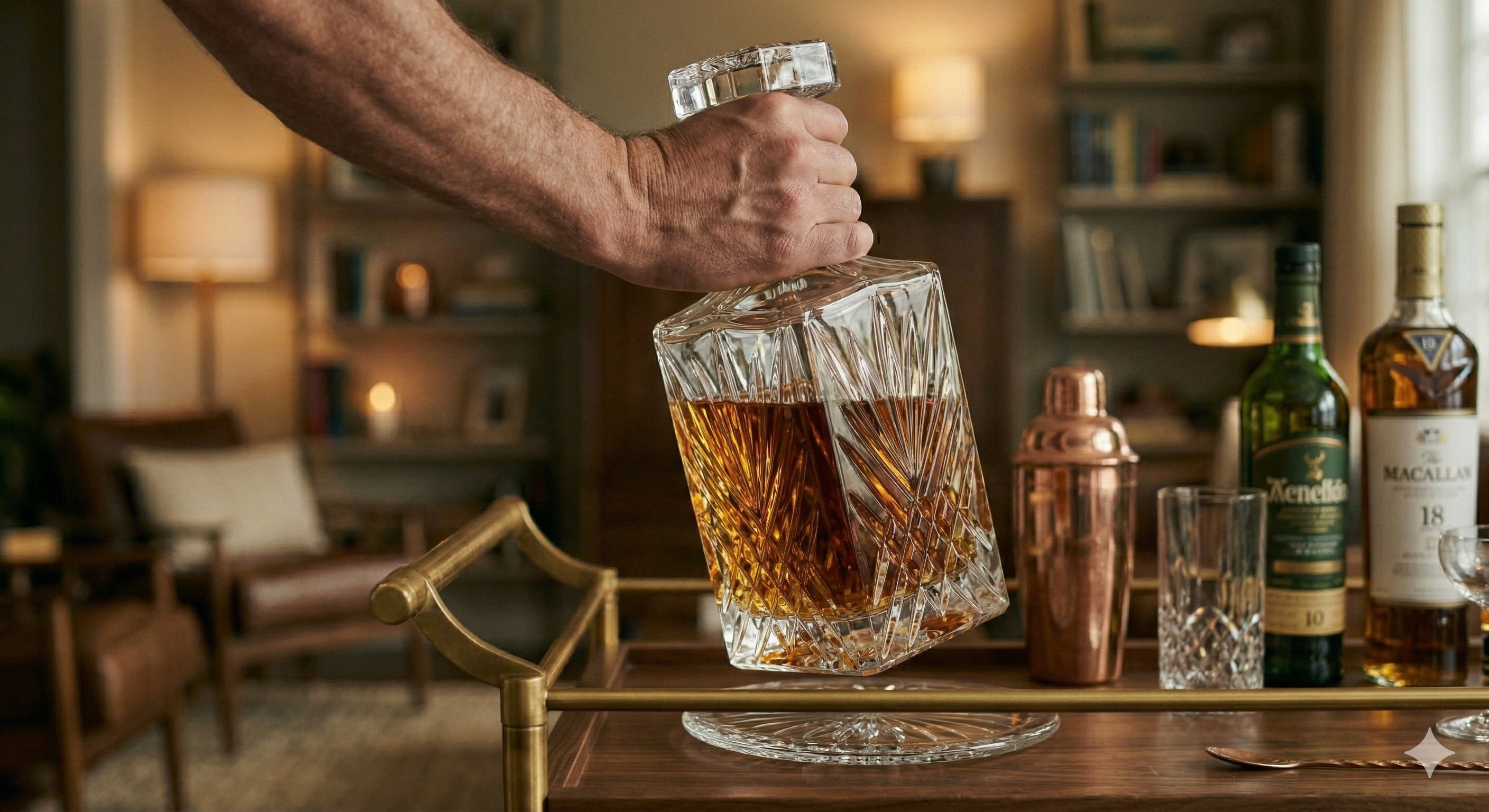
The difference between these two is not always visible to the naked eye at first glance. The tilt test is the only reliable way to check. Fill your decanter partially, seat the stopper, and gently tilt it over a sink. Any seepage means the seal is inadequate for extended storage.
Plastic-gasketed stoppers sit in the mid-tier of decanter construction. A flexible plastic membrane around the base of the glass stopper compensates for a less precise fit and generally outperforms a loose glass-on-glass seal. The trade-off is longevity: plastic gaskets harden over time and eventually lose their elasticity, at which point the seal degrades even if it was initially tight. If your decanter uses this type, replace the gasket before it stiffens rather than after.
Cork stoppers, while not common in decorative decanters, offer the most reliable airtight seal of the three. Some enthusiasts replace decorative glass stoppers with a wine cork for long-term storage, accepting the aesthetic compromise in exchange for better preservation. It works, but it does defeat the visual purpose of a premium decanter.
Every decanter in the Hydro Gizmos luxury collection uses precision-machined glass-on-glass stoppers tolerance-tested before leaving production. The goal is a seal that holds visually and functionally, so the stopper earns its place rather than just filling it.
What Happens When the Seal Fails
A leaking stopper does not produce a sudden, obvious problem. It produces a slow one, which is why so many decanter owners do not connect the flat pour to the loose seal.
Here is the sequence. Oxygen enters through the gap around the stopper. It begins reacting with the aromatic compounds in the whiskey, the esters, aldehydes, and terpenes responsible for the nose and finish. Alcohol, which evaporates faster than water at room temperature, escapes through the same gap. Over two to four weeks with a poorly sealed decanter, proof drops slightly, the nose softens noticeably, and the finish shortens. The whiskey is still drinkable. It is just not the whiskey you paid for.
Headspace makes this worse. The more air inside the decanter above the liquid level, the larger the oxygen reservoir reacting with your whiskey. A half-empty decanter with a loose stopper oxidizes faster than a full one with the same seal. If you are storing a decanter long-term, keeping it topped up is nearly as important as the stopper quality.

A collector who pours three or four fingers into a decanter for a dinner party and leaves the rest sitting for six weeks will notice this effect far more than someone who cycles through a full pour in two weeks. The ritual use case, where the decanter is filled and emptied regularly, is exactly the environment a well-sealed decanter was designed for.
Our post on what makes a good whiskey decanter covers stopper engineering alongside the other quality signals that separate a premium piece from a decorative one.
How to Test Your Decanter Seal Right Now
You do not need any tools. This takes under two minutes.
Fill your decanter to approximately one-third capacity. Seat the stopper firmly, pressing down with light, even pressure. Hold the decanter over a sink and tilt it to about a 45-degree angle. Hold it there for ten seconds. No drips or seepage means your stopper is performing correctly.
If liquid seeps around the stopper, you have two options. First, try rotating the stopper a quarter turn and reseating it. Some glass-on-glass stoppers have a slightly better-fit orientation due to minor asymmetry in the grind. Second, wrap one or two layers of plumber's PTFE tape around the base of the stopper before inserting it. This is a widely used fix in the whiskey community and adds enough friction to compensate for a marginal gap without affecting the appearance from above.
If neither fix works, the stopper geometry is too far off for the neck to create a functional seal. In that case, the decanter is better suited to display than to storage. You can still use it for same-session serving, pouring what you plan to drink that evening and returning the rest to the original bottle.
Knowing whether are whiskey decanters safe for extended use is the companion question to seal quality, and that post addresses the lead-free question alongside stopper performance.
The Seal and Lead-Free Question Are Linked
It is worth addressing both together because buyers often ask one without thinking about the other.
A perfectly airtight stopper on a lead crystal decanter still creates a problem for long-term storage. Traditional crystal contains between 18% and 38% lead oxide, which can leach into spirits during extended contact. The seal keeps oxygen out, but it also keeps the whiskey in contact with the glass for weeks or months, which is exactly the condition under which lead migration occurs.
The correct answer is both: airtight stopper and lead-free glass. One without the other solves only half the problem. For anyone storing whiskey in a decanter for more than a few days at a time, the material of the glass is not a secondary concern. It is equal in importance to stopper quality.
This is why every Hydro Gizmos decanter is built with certified lead-free crystal as standard, not as a premium add-on. Pairing that with a precision stopper means the decanter does its job fully, not partially. For more on how does a whiskey decanter change the taste when these variables are managed correctly, that post covers the flavor science in practical terms.
What a Properly Sealed Decanter Actually Delivers
When the stopper fits correctly and the glass is lead-free, the decanter stops being a liability and becomes what it was always meant to be.
Your whiskey stays fresh for 2 to 4 weeks of regular use without any perceptible change. Poured for guests, it looks and tastes exactly as intended. The ritual of pouring from a heavy, well-sealed crystal decanter changes how the moment feels. Not because of any chemical aeration effect, but because the vessel communicates something about the care and intention behind the pour.
That is the case for getting the seal right. Not just to protect the whiskey. But to make sure the experience the decanter promises is the one it actually delivers. Browse the full range of Hydro Gizmos whiskey decanter sets built to that standard.
Frequently Asked Questions
Do whiskey decanters need to be completely airtight?
Whiskey decanters do not need to achieve a perfect laboratory-grade vacuum seal, but they need to be as airtight as practically possible to protect the whiskey from oxidation and alcohol evaporation. A precision-fit glass-on-glass stopper that passes the tilt test provides adequate protection for 2 to 4 weeks of regular use. For storage beyond one month, a tighter seal becomes increasingly important as cumulative air exposure builds up over time.
How do I know if my decanter stopper is airtight enough?
The tilt test is the most reliable check: fill the decanter partially, seat the stopper firmly, and tilt it over a sink at a 45-degree angle for ten seconds. Any seepage indicates a seal that is not airtight enough for extended whiskey storage. A properly fitted stopper should show zero leakage during this test and should sit flush at eye level with no visible gaps around the seal line.
How often should I check my decanter stopper seal?
Check the seal every time you refill the decanter and at least once a month if the decanter sits filled between uses. Stoppers can shift slightly during handling, and plastic gaskets degrade over time. A quick tilt test takes under a minute and catches seal failures before they affect your whiskey. If you notice the nose or flavor softening, check the seal before assuming the whiskey itself has changed.
Does a better stopper seal cost significantly more?
Precision-ground glass-on-glass stoppers that create near-hermetic seals are standard features of quality decanters in the $60 to $150 price range. The cost difference between a well-sealed premium decanter and a cheaply made one is often less than $30, but the performance difference across weeks of storage is significant. Investing in a properly sealed decanter once is less expensive than replacing whiskey that has lost its character due to a loose stopper.
What is a glass-on-glass stopper and why does it matter?
A glass-on-glass stopper is a closure where both the stopper and the neck of the decanter are made from glass, with the stopper ground to fit the neck precisely. When manufactured correctly through a process called lapping, the two surfaces create a near-hermetic seal that limits oxygen and alcohol vapor from passing through. When manufactured poorly, the same design leaves visible gaps that allow continuous air exchange. The quality of the grind, not the material itself, determines whether a glass-on-glass stopper performs as intended.
Is a corked decanter better than a glass stopper for keeping whiskey fresh?
A cork stopper generally provides a more reliable airtight seal than a glass-on-glass stopper of average quality, because cork compresses to fill irregular gaps that glass cannot accommodate. However, a precision-ground glass stopper of premium quality will match or exceed cork performance while maintaining the visual integrity of the decanter. For purely functional long-term storage, cork wins. For a combination of reliable sealing and premium aesthetics, a well-machined glass stopper is the better choice.
FIND A DECANTER THAT ACTUALLY SEALS
You know what to look for now. Here is where to find it.
Every Hydro Gizmos decanter is built with a precision-machined glass stopper, certified lead-free crystal, and tested seal tolerance before it ships. No guesswork. No tilt-test surprises.
When you shop Hydro Gizmos, you get:
-
Precision-fit glass-on-glass stoppers tested for seal performance before dispatch
-
Certified lead-free crystal safe for regular, extended use
-
Heavy, hand-finished glass that signals quality before the first pour
-
Gift-ready magnetic closure packaging included as standard, no wrapping required
Shop All Whiskey Decanter Sets
Not ready to buy yet? Browse the full Hydro Gizmos luxury decanter range to compare styles and find the right fit for your bar or your next gift.


Share:
How Long Can You Store Whiskey in a Decanter? The Honest Answer
Cheap vs Premium Whiskey Decanter: How to Tell the Difference