
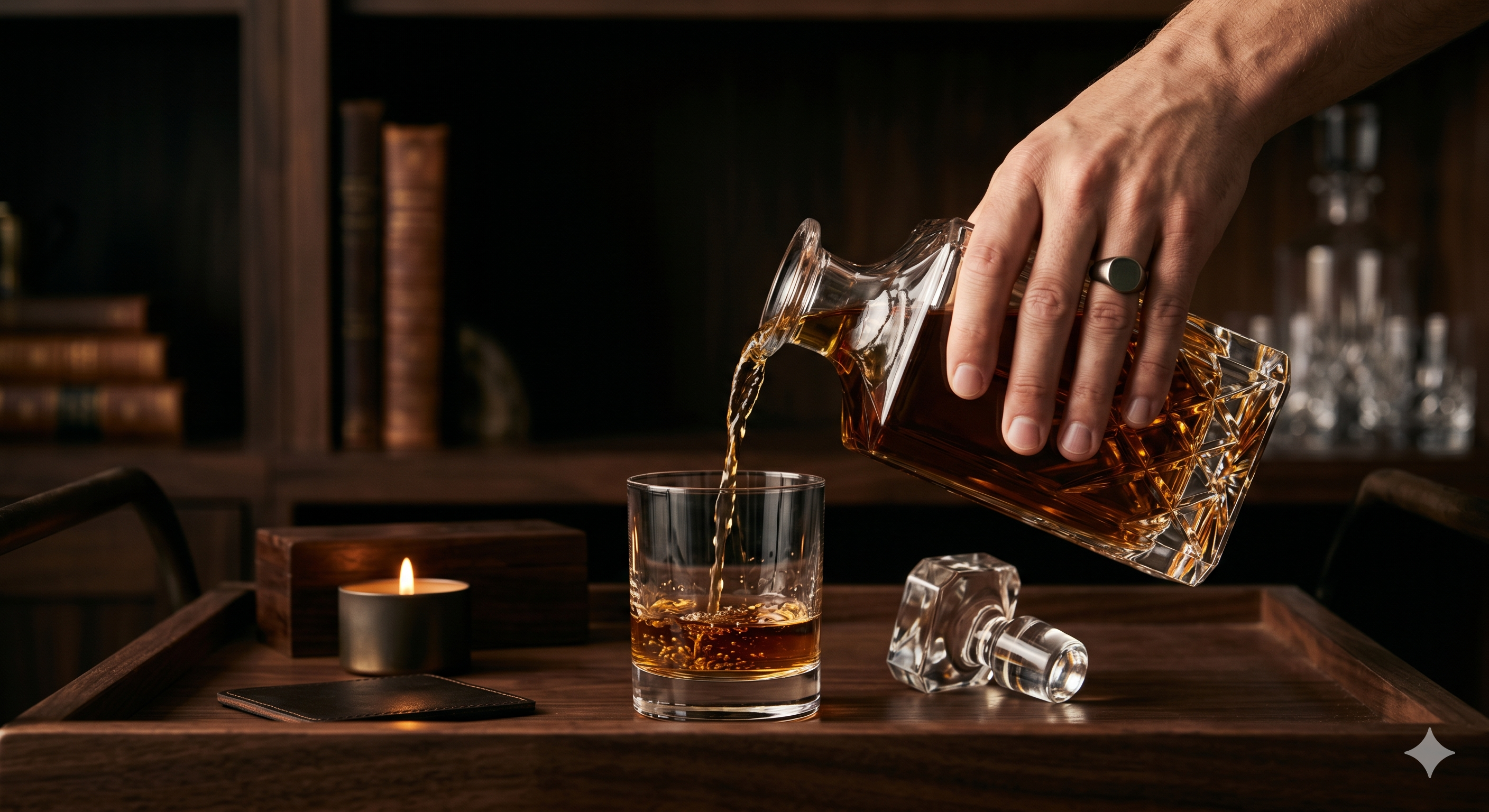
You filled your decanter. It looks incredible on the bar cart. Then a week passes, and you haven't touched it. A month goes by. Now you're standing there wondering whether the whiskey inside is still any good, or whether you just let a $60 bottle quietly turn on you.
This is one of the most common sources of anxiety for decanter owners, and almost nobody gives a straight answer. Most articles hedge so heavily that you leave more confused than when you arrived. The truth is not complicated, but it does depend on a few specific variables that are worth understanding before you pour.
This post gives you the full picture: what actually affects whiskey stored in a decanter, how long different scenarios realistically last, and what you can do to get the most out of your decanter without overthinking it.
The Direct Answer
You can safely store whiskey in a lead-free crystal decanter for 1 to 3 months without meaningful flavor loss, provided the stopper fits tightly and the decanter sits away from direct light and heat. For everyday display and regular pouring, 2 to 4 weeks is the sweet spot where whiskey tastes exactly as it should. Beyond 3 months in a decanter, you risk subtle oxidation, slight alcohol evaporation, and a softer nose.
What you need to know at a glance:
-
Safe short-term storage: 2 to 4 weeks is ideal for regular use with no noticeable change
-
Maximum recommended time: Up to 3 months in a well-sealed, lead-free decanter
-
Biggest risk factor: A loose or poorly fitting stopper, not the glass itself
-
Lead-free matters: Traditional lead crystal leaches into spirits over time; always choose certified lead-free glass
-
Light is the silent enemy: Direct sunlight and bright ambient light degrade whiskey faster than air exposure
-
Original bottles win for long storage: If you are cellaring a bottle for over 3 months, keep it sealed in the original bottle
-
Decanters are for the ritual, not the archive: A decanter is a pouring vessel and bar-cart centerpiece, not a long-term storage solution
-
Infinity Bottle exception: Blending decanters used regularly for an Infinity Bottle project cycle whiskey through fast enough that storage duration is rarely a concern
The Stopper Is the Whole Game
The single biggest factor in how long your whiskey holds up in a decanter is not the glass, the shape, or the size. It is the stopper.
Why it matters: Whiskey is a high-proof spirit, typically between 40% and 50% ABV, which gives it natural preservation properties that wine simply does not have. Unlike an opened wine bottle, whiskey does not spoil quickly on contact with air. What it does do, over weeks and months, is slowly oxidize, lose volatile aromatic compounds, and drop slightly in proof as alcohol evaporates faster than water.
Why it costs you quality: The rate at which all of that happens is almost entirely determined by how airtight your stopper is. A tight-fitting, well-machined glass stopper slows oxidation dramatically. A loose stopper that rattles or allows visible gaps accelerates the process. In one widely referenced enthusiast experiment on Reddit, a decanter with significant headspace and a loose stopper showed obvious changes in alcohol character within four months compared to a control bottle kept sealed.
How to check right now: Pick up your decanter stopper and hold it at eye level. It should sit flush with no visible daylight around the seal. Tilt the filled decanter slightly over a sink. If any liquid seeps past the stopper, that same gap is letting air in continuously. That is the problem.
The Hydro Gizmos fix: Every decanter in the Hydro Gizmos collection is engineered with precision-fit glass stoppers designed to minimize air exchange without sacrificing the satisfying heft and aesthetic of a traditional seal. Our team specifically tests stopper tolerance before any product goes to market, because a dripping or rattling stopper is the fastest way to ruin both the whiskey and the experience.
Lead-Free Glass Is Not Optional
If you have an older decanter, a vintage piece, or anything that is not explicitly labeled as lead-free, storage time matters a great deal more than you might assume.
What it means: Traditional lead crystal contains between 18% and 38% lead oxide, which gives it that brilliant sparkle and satisfying weight. It also means that when high-proof spirits sit in contact with that glass over days and weeks, measurable lead can migrate into the liquid. For a single evening of use, the risk is negligible. For storage measured in weeks or months, it is a real concern that serious enthusiasts and health-conscious buyers should not dismiss.

Why it affects your storage timeline: With a lead crystal decanter, the recommended maximum storage time drops significantly, often to just a few days, because the chemistry of the interaction between alcohol and lead oxide accelerates with contact time. With a certified lead-free crystal decanter, this concern disappears entirely, and you can comfortably store whiskey for the 1 to 3 month window without any health-related anxiety.
How to check right now: Look at the product listing, box, or underside of your decanter. It should explicitly state "lead-free crystal" or "lead-free glass." If it says only "crystal" with no lead-free certification, assume it contains lead and limit storage time accordingly.
The Hydro Gizmos fix: All Hydro Gizmos decanters are manufactured with certified lead-free crystal. This is not a footnote. It is front and center in every product description because our research consistently shows it is the single most important purchase factor for buyers who plan to use a decanter regularly. You can read more about are whiskey decanters safe on our blog, including exactly what to look for on labels.
Light and Heat Quietly Degrade Your Whiskey
You did everything right. Lead-free glass, tight stopper, good whiskey. But the decanter sits on a windowsill or under under a warm spotlight. In this case, the light and heat are working against you faster than any stopper problem.
What it means: Whiskey bottles are typically amber, brown, or opaque for a reason. UV light and sustained heat both accelerate the breakdown of volatile flavor compounds, the same chemical components responsible for the nose and finish you paid for. A clear glass decanter sitting in direct sunlight is receiving constant light exposure that a dark bottle on a back shelf never would.
Why it costs you flavor: In practical terms, a whiskey stored in a clear decanter near a bright window can show noticeable flavor softening within 3 to 4 weeks. The same whiskey in the same decanter, stored in a cool dark cabinet, could maintain its character for 2 to 3 months without meaningful degradation. The variable is entirely environmental.
How to check right now: Stand at your bar cart or wherever your decanter lives. At the brightest point of the day, observe whether direct sunlight falls on the decanter. If it does, move it. If it sits under halogen or warm-spectrum spotlights that run for hours daily, consider relocating it to a shelf that gets ambient rather than direct light.
The Hydro Gizmos fix: We always recommend treating your decanter like a great bottle of whiskey: a cool, dimly lit spot where the decanter can be admired without being compromised. Our whiskey decanter sets are designed to be bar-cart centerpieces that look just as impressive in a warm, sheltered setting as they do under dramatic lighting.
When the Original Bottle Is Simply Better
There is a question worth answering honestly: when should you not use a decanter for storage?
If you have opened a bottle you do not intend to drink within 2 to 3 months, the original bottle with its factory seal reseated is the better storage vessel. It has a tighter closure than almost any decorative glass stopper, it protects against light, and it keeps provenance information intact.
Decanters are not better for long-term whiskey storage. That is not a weakness of the product. It is an honest framing of what a decanter actually is: a ritual object, a pouring vessel, and a statement piece that transforms the experience of serving whiskey. The difference between a whiskey decanter and the original bottle is not about preservation. It is about presentation, ritual, and the moment you share with someone.
If you are building an Infinity Bottle, blending small pours from multiple bottles into one, the cycling of whiskey in and out keeps freshness high and makes storage duration largely irrelevant. It is one of the best use cases for a decanter, and one we recommend exploring for any enthusiast who wants to get more from their bar.
Practical Storage Timeline at a Glance
|
Timeframe |
What to Expect |
|
1 to 2 weeks |
No change. Pour and enjoy freely. |
|
2 to 4 weeks |
Ideal window. Whiskey is at its best in a well-sealed decanter. |
|
1 to 3 months |
Minimal change if stopper is tight, glass is lead-free, and decanter is away from light. |
|
3 to 6 months |
Possible softening of the nose and slight flavor flattening. Still safe to drink. |
|
6+ months |
Real risk of noticeable oxidation and proof drop. Return to original bottle for long-term holds. |
A Note on What Makes the Experience Worth It
When we ask what makes a good whiskey decanter, the answer almost never comes down to storage science. It comes down to weight, presence, the sound of the stopper settling into place, and the way light moves through the glass when you pour. These are the things that make the ritual feel like a ritual.

The question of what makes a good whiskey decanter goes deeper than chemistry. It is about choosing something that earns its place on the bar and makes every pour feel intentional. That is the standard Hydro Gizmos builds to.
Frequently Asked Questions
How long can you store whiskey in a decanter before it goes bad?
Whiskey stored in a lead-free crystal decanter with a tight-fitting stopper, kept away from direct light and heat, will remain in excellent condition for up to 3 months. For everyday use, the ideal window is 2 to 4 weeks. Whiskey does not spoil the way wine does, but its aroma compounds, proof, and flavor balance can shift gradually with air and light exposure over time.
Does storing whiskey in a decanter change the taste?
Storing whiskey in a decanter can produce subtle changes over time, particularly a softening of the nose and a slight mellowing of sharper notes, due to gentle oxidation through the stopper seal. For most drinkers, these changes are barely perceptible within the first month. If you are curious whether your specific decanter affects flavor, our blog post on does a whiskey decanter change taste explores this in detail with practical examples.
Is it safe to store whiskey in a crystal decanter?
It is safe to store whiskey in a certified lead-free crystal decanter for extended periods. Traditional lead crystal decanters, which contain 18 to 38 percent lead oxide, can leach lead into spirits during extended contact, making them unsuitable for long-term storage. Always verify that a decanter is explicitly labeled as lead-free before using it for anything beyond a single evening of service.
How do I know if my decanter stopper is airtight enough?
Hold the stopper at eye level and check that it sits flush with no visible gaps around the seal. You can also do a tilt test: fill the decanter partially, seal it, and gently tilt it over a sink. Any seepage indicates a loose seal that will allow air in during storage. A well-machined stopper should resist this test completely.
What is the best way to store a decanter when not in use?
Store an empty decanter upright with the stopper removed to allow air circulation and prevent any residual moisture from producing odors inside. Do not seal an empty decanter for extended periods. When storing a filled decanter, keep it in a cool, dark place away from direct sunlight, heat sources, and prolonged exposure to bright ambient lighting.
Should I keep whiskey in a decanter or the original bottle?
For whiskey you plan to drink within 4 weeks, a high-quality decanter is an excellent choice that elevates the experience of pouring and serving. For whiskey you are storing beyond 3 months, the original factory-sealed bottle is the better preservation vessel. It has a tighter closure and protects against light. The decanter wins on presentation and ritual. The original bottle wins on long-term preservation. Use both accordingly.
SHOP HYDRO GIZMOS DECANTER SETS
You have just read the honest answer. Now get the right decanter to back it up.
Hydro Gizmos designs premium, certified lead-free crystal decanter sets built for the ritual of whiskey, not just the storage of it. Every set ships in gift-ready presentation packaging, every stopper is tolerance-tested, and every piece of glass meets our weight and clarity standards before it reaches your bar.
When you shop Hydro Gizmos, you get:
-
Certified lead-free crystal confirmed safe for extended use
-
Precision-machined stoppers designed to minimize air exchange
-
Gift-ready magnetic closure packaging included as standard
-
A full range of styles, from modern geometric to classic globe designs
Browse the full Hydro Gizmos collection or explore our luxury engraved whiskey decanter sets for gifting occasions.

Share:
Whiskey Decanter vs Original Bottle: Should You Transfer Your Whiskey?
Do Whiskey Decanters Need to Be Airtight? Yes — Here's Why It Matters