

The twisted decanter is one of the few barware designs that genuinely splits buyers. Online, product shots flatten the spiral body into something that looks either striking or theatrical depending on your tolerance for the unusual.
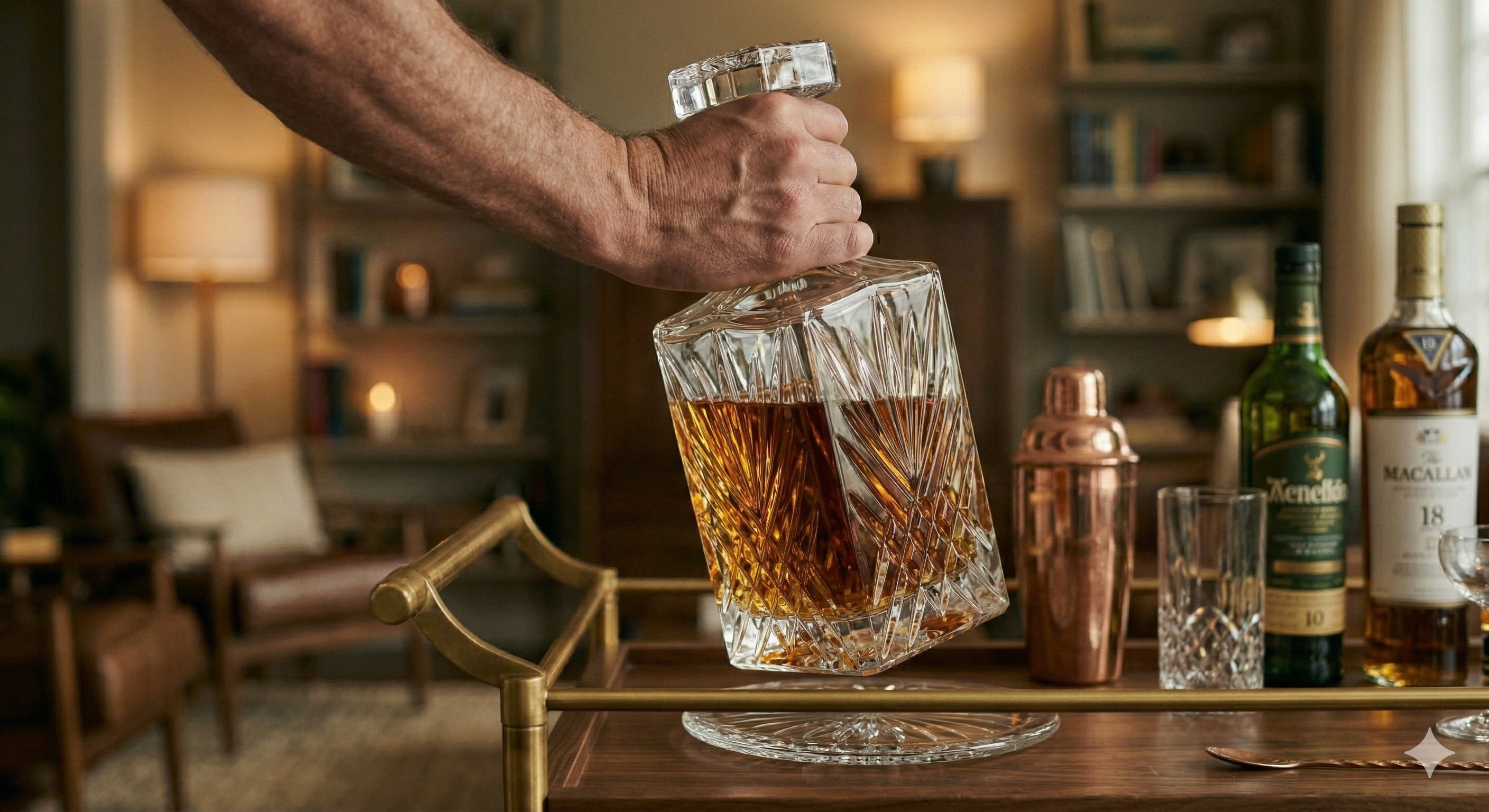
In person, the effect is entirely different: the spiral columns catch light from multiple angles simultaneously, the glass feels substantial in the hand, and the overall silhouette does exactly what a bar cart centrepiece is supposed to do. Guests ask about it before they ask about the whiskey inside.
The confusion is understandable. Most people searching for a twisted decanter have already seen the standard options, the classic cylinder, the globe, the wide-bottomed diamond cut, and want something that reads as distinctive without crossing into novelty.
That distinction matters, and the twisted form sits squarely on the right side of it. This post explains what the design actually looks like, how it is constructed, and why it works as both a daily-use vessel and a bar display piece.
|
TL;DR A twisted decanter uses a spiral body formed during the glass-blowing process to refract light continuously as the viewing angle changes. The design is not decorative embellishment applied after the fact: the twist is structural. It does not affect pour quality or meaningful cleaning difficulty. Lead-free crystal is the material standard to look for. The twisted form is one of the most visually distinctive shapes available in the decanter category. |
What Makes the Twisted Decanter Design Different?
Most decanter bodies are static. A globe is a globe. A diamond-cut cylinder presents the same face from every angle. The twisted decanter body is different in one specific way: it moves optically without moving physically. As you walk past it, or as light in the room shifts, the columns of the spiral refract at different angles, creating a visual impression of depth and motion that flat or uniform shapes simply do not produce.

This is not a trick of photography. Product shots of twisted decanters are frequently the worst representation of the design because a camera captures a single fixed angle. The actual visual impact is accumulated over multiple viewing angles in sequence, which is precisely how guests encounter objects on a bar cart: in passing, in low light, from across a room.
What Does a Twisted Decanter Look Like in Person?
The spiral body reads as substantially more three-dimensional in person than online. The columns of the twist create ridges that catch overhead or ambient light along their highest point while the channels between them sit in relative shadow. At close range, you can follow the spiral from the base to the shoulder of the decanter with a finger without the design appearing to end or repeat, because it does not: the twist is continuous. The stopper on a quality piece extends the geometry upward, maintaining the design language without adding visual clutter.
The base is typically wider and heavier than the body suggests from a distance. Premium lead-free crystal twisted decanters carry significant weight in the hand, which matters both functionally (stability on a bar surface) and psychologically. The weight is the first thing most people comment on when they pick one up.
How Is a Twisted Decanter Made?
The spiral form is created during the glass-forming process, not after. In hand-finished production, the glass is shaped while it is still in its malleable state, and the twisting motion is applied to the body before the glass fully sets. The result is a continuous, seamless spiral that is part of the vessel's structure rather than a pattern cut or etched onto a finished surface.
This is the critical distinction between a genuinely constructed twisted decanter and lower-quality versions where a spiral pattern is machine-pressed or moulded into a thinner glass body. The difference is visible in two ways: the depth of the spiral columns (hand-finished pieces have more pronounced ridges and more dramatic light refraction), and the overall wall thickness and weight of the glass.
Why Does a Twisted Decanter Cost More Than a Standard Cylinder?
Two factors drive the cost differential.
First, the forming process for a twisted body requires more time and skill than a uniform cylinder or a globe, which can be produced to tight tolerances by automated glassblowing machinery.
Second, premium twisted decanters use lead-free crystal rather than standard glass, which achieves 90-92% of the optical clarity of traditional lead crystal without the health concerns associated with long-term contact between acidic spirits and leaded glass. The combination of a more complex forming process and higher-specification material justifies the price premium over commodity options.
Does the Twisted Design Affect Pour Quality or Cleaning?
Pour quality from a twisted decanter is unaffected by the body shape. The relevant variables are the neck width, the stopper fit, and the opening diameter at the top, none of which are determined by whether the body is twisted or straight. A well-made twisted decanter pours cleanly without dripping or splashing for the same reason any quality decanter does: precision at the neck and stopper, not uniformity of the body.
Is a Twisted Decanter Hard to Clean?
The exterior spiral does not affect cleaning in any meaningful way. The interior of a quality twisted decanter has a smooth glass wall regardless of the external twist. Standard decanter cleaning works: hot water rinsing, bottle brushes for the interior, and decanter cleaning beads or a diluted white vinegar rinse for stubborn residue. The common concern that the exterior ridges accumulate fingerprints more visibly than a smooth surface is accurate but not a maintenance issue, it is a display consideration addressed by handling from the base rather than the body.
Is a Twisted Decanter a Good Gift?
For a whiskey drinker who already owns a decanter, a twisted decanter offers something a repeat gift of the same design cannot: a different visual language. The gift question with barware is almost always about whether the recipient will display it or use it. A twisted decanter answers both with the same object: it displays exceptionally well on a bar cart and functions as a daily-use vessel for any whiskey the recipient wants to serve.

The shape also reads as considered rather than generic. A globe decanter is everywhere. A diamond-cut cylinder is familiar. A well-made twisted decanter with a matched set of glasses signals that the giver looked further than the first search page, which is a meaningful signal in gift-giving regardless of price point.
The Hydro Gizmos twisted decanter set pairs the spiral-body decanter with matched glasses in lead-free crystal. For comparison with other shapes in the same range, the whiskey decanter shapes guide covers the full design family.
The Twisted Decanter Among the Shape Options: Where It Sits
The full decanter collection includes four distinct designs: globe, modern geometric, twisted, and fashion. Each occupies a different visual register:
The globe is the architectural statement. It dominates a shelf by mass. The modern geometric is the clean-lined option for minimal or contemporary bar aesthetics. The twisted is the design for rooms where the bar cart is in the line of sight and the object needs to hold attention over time rather than just on first encounter. The fashion decanter is the angular, pattern-forward choice.
None of these is a better decanter functionally. The choice is about the visual environment it will live in and the kind of attention the owner wants it to attract.
The Object That Does Not Look the Same Twice
The twisted decanter earns its place on a bar not through novelty but through optics. The spiral body is a permanent light-interaction engine: every change in ambient light, every shift in viewing angle, produces a slightly different visual impression. That sustained engagement is what separates a bar cart centrepiece from bar cart clutter.
For buyers who have been uncertain whether the design works in person: it does, in precisely the way that product photos cannot communicate. The twist is not a design applied to glass. The glass is the twist.
See the twisted decanter set at Hydro Gizmos, alongside the full range of lead-free crystal decanter sets.

Share:
What to Do With Whiskey You Don't Love: The Decanter Solution Most People Miss