
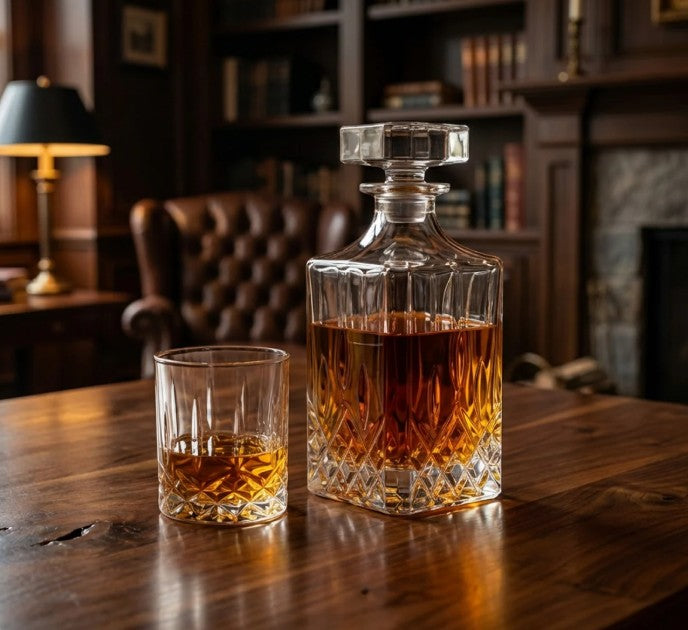
The thing that makes a home bar look expensive is almost never the whiskey inside it. In the largest enthusiast communities online, the most repeated home-bar “trick” is pouring a $20 bottle into a heavy decanter — and watching guests assume it cost ten times that. One Reddit user put it plainly: a decanter is “one of the greatest party tricks” because guests “will try it and think it’s something expensive.” That single insight should reorder how you spend your first few hundred dollars.
If you’ve ever looked at your own setup and felt it reads more dorm-room than den, you’re reacting to a real signal, not vanity. A bar that looks cheap usually isn’t under-stocked — it’s missing the four or five presentation pieces that do the visual heavy lifting. Most checklists bury those under a wall of bottle recommendations.
This guide fixes that. Below are nine things every home bar actually needs, ranked by how much they change the way the bar looks and feels — not by how much they cost. You’ll know exactly what to buy first, what to skip, and why the cheapest upgrades often land hardest.
TL;DR: A good home bar needs nine things: a decanter, two types of glassware, large-format ice, a cocktail shaker, a jigger, a bar spoon, a strainer, a few core spirits, and a tray or surface to anchor it all. The decanter and ice do the most to make a setup look premium. Start with presentation pieces, then add tools, then bottles — most cost under $50.
1. A decanter — the piece that does the most visual work
A whiskey decanter is the single highest-impact item on this list because it changes how everything around it is perceived. It is the anchor object on a home bar: the piece guests look at first and judge the rest of the setup against. Weight, clarity, and a clean stopper are what register as “expensive” in the first three seconds.

The trap is buying on looks alone.Customers often complain about thin glass, loose stoppers, and “crystal” that arrived as painted plastic, the exact opposite of the effect you’re paying for.
Weight is the proxy buyers trust: a heavy base reads as quality, a light one reads as a prop. If you pick up only one piece, a solid modern decanter set is the one that makes the rest of the bar look intentional. For the full range, the luxury decanter collection covers heavier statement pieces.
Spend time here first. Nothing else on this list returns as much perceived value per dollar.
2. Two types of glassware (not five)
Most home bars need exactly two glass shapes to cover nearly every drink: a rocks glass and a coupe. Rocks glasses handle spirits neat, on the rocks, and short cocktails like the Old Fashioned; coupes cover everything shaken or stirred-up, from a Daiquiri to a Martini. Buying a cabinet full of specialist shapes is how people end up with clutter that still can’t serve a guest properly.
The practical reality: matching matters more than variety. A set of four identical rocks glasses looks deliberate; a shelf of mismatched freebies looks like a junk drawer, no matter how nice any single glass is. Heavy-based rocks glasses also echo the weight cue from the decanter, so the bar reads as one coordinated set rather than a collection of accidents.
Skip the shot glasses unless you actually do shots — they age a setup faster than almost anything. Start with four rocks and two coupes, and add from there only when a specific cocktail demands it.
3. Large-format ice — the cheapest upgrade that looks the most expensive
A single large ice cube or sphere is the lowest-cost item on this list and one of the most visible. Big ice melts slower, so it dilutes a drink less, and a clear two-inch cube sitting in a heavy rocks glass is the visual shorthand for a proper cocktail bar. The cost difference versus a standard ice tray is a few dollars.
What goes wrong: cheap flexible trays produce cloudy, cracked, oddly-shaped cubes that undercut the whole effect. The fix is a proper silicone mold with a lid that releases cleanly and keeps freezer odors out. A set of large ice cube trays is the kind of $15 buy that punches far above its price the moment you hand someone a drink.

If you’re hosting summer watch parties or warm-weather gatherings, this one earns its place faster than any bottle.
4. A cocktail shaker (and which kind to start with)
A cocktail shaker is the one tool that unlocks the largest jump in what you can make. It chills and combines any shaken drink Margaritas, Daiquiris, Whiskey Sours, Espresso Martinis — which is most of the crowd-pleasers. Without one, you’re limited to stirred and built drinks.
There are two real options. A cobbler shaker (three pieces, built-in strainer) is the easier starting point because it strains for you and looks tidy on display. A Boston shaker (two pieces) is what bartenders use faster and more durable, but it needs a separate strainer and a bit of practice to seal and open. For a first home bar, start with a cobbler; graduate to a Boston once shaking feels natural. A wider range of bar tools and accessories lets you fill the gaps as your menu grows.
5. A jigger — the difference between a cocktail and a guess
A jigger is a small dual-sided measure, and it’s what makes a cocktail taste the same twice. Most home drinks fail not because of the recipe but because they’re poured by eye a heavy hand on the spirit or a light one on the citrus throws the whole balance off. A jigger removes the guesswork for a few dollars.
The honest caveat: free-pouring is a skill, and experienced hosts do it well. But it takes hundreds of reps to calibrate, and until then a jigger is the shortcut to drinks that don’t taste “off.” A standard 1oz / 2oz jigger covers nearly every classic recipe. It’s the least glamorous item here and one of the most important.
6. A bar spoon and strainer for stirred drinks
A long bar spoon and a Hawthorne strainer are the pair that handle stirred cocktails — the Old Fashioned, Manhattan, Negroni, and Martini families. Stirred drinks are built for clarity and texture rather than aeration, which is why you stir rather than shake, and a long spoon lets you do it in a tall mixing glass without bruising the drink.
The strainer matters more than people expect. If you start with a Boston shaker (no built-in strainer), a Hawthorne is non-negotiable for getting ice and pulp out of the glass. Together these two tools cost very little and complete the core kit: with a shaker, jigger, spoon, and strainer, you can build the overwhelming majority of classic cocktails.
7. A handful of core spirits — buy fewer, buy better
A versatile home bar needs roughly five to six bottles, not twenty. The standard core is a bourbon or rye, a gin, a blanco tequila, a white rum, and a bottle of Angostura bitters; add sweet and dry vermouth if you want Manhattans and Martinis. That short list covers dozens of classic cocktails, which is more range than most people will ever use.
The mistake almost everyone makes is breadth over quality — a graveyard of half-used bottles bought for one recipe. One well-chosen bourbon you actually drink beats six novelty bottles gathering dust. And because the decanter already carries the premium impression, your everyday pour doesn’t need to be top-shelf to look at it. That’s the quiet economics of presentation: the vessel lets the contents be sensible.
One storage note specific to whiskey: a decanter is for short-term display and serving, not long-term aging. Enthusiasts are near-unanimous that you shouldn’t store your best bottle in one for months keep the decanter for the pour and the moment, and leave long-term storage to the original bottle.
8. A tray or defined surface to anchor it all
A bar needs a defined surface: a tray, a cart shelf, or a dedicated section of counter to read as a bar rather than bottles left on a counter. Containment is what turns a scattering of objects into a setup. A simple tray with a raised edge groups the decanter, glasses, and tools into a single intentional vignette and protects the surface underneath from rings and spills.
This is where presentation and styling overlap. If you’re building out a full cart rather than a tray, the styling decisions what to display versus store, how to layer height, where the decanter sits deserve their own treatment.
9. The one thing to skip: whiskey stones
Whiskey stones are the home-bar purchase most likely to disappoint, and worth skipping on a starter list. The pitch is that they chill without diluting, but in practice they barely cool the drink and serious whiskey drinkers widely regard them as a gimmick. Search interest in them has been falling while interest in large-format ice rises, which tells you where experienced drinkers have landed.
If your goal is cold whiskey without watering it down, a single large ice cube (see #3) does the job better and looks the part. Spend the stone money on better ice or a heavier rocks glass instead. Naming what to skip is part of an honest list — not everything marketed as a “whiskey essential” earns the shelf space.
What to buy first if you’re starting from scratch
If you’re building from nothing, buy in the order that changes the look and capability fastest, not the order of price. The presentation pieces come first because they reset how the whole bar is perceived; the tools come next because they unlock what you can make; the bottles come last because they’re the easiest to add over time.
|
Priority |
Buy |
Why first |
Rough cost |
|---|---|---|---|
|
1 |
Decanter |
Anchors the look; makes everything else read premium |
$40–$90 |
|
2 |
Large-format ice tray |
Cheapest visible upgrade; instant “proper bar” cue |
Under $20 |
|
3 |
4 rocks + 2 coupe glasses |
Covers most drinks; matching set looks deliberate |
$30–$60 |
|
4 |
Shaker + jigger + spoon + strainer |
Unlocks the majority of classic cocktails |
$30–$50 |
|
5 |
5–6 core spirits |
Range without waste; easiest to add gradually |
Varies |
|
6 |
Tray or cart surface |
Turns objects into a setup |
$20–$50 |
The pattern holds across every piece: the items that make a home bar look expensive are mostly the cheap ones. The bottles are where the money seems to go and the presentation is where the impression is actually made.
Common questions about home bar essentials
What is the most essential item for a home bar?
A decanter is the highest-impact single item, because it anchors the look and makes everything around it read as more premium. If you can only buy one piece to start, buy the vessel before the bottles — it changes the impression of the entire setup.
How many bottles do I actually need for a home bar?
Five to six core bottles cover most classic cocktails: a bourbon or rye, gin, blanco tequila, white rum, and Angostura bitters, plus vermouth if you want Manhattans and Martinis. Buying fewer, better bottles beats a shelf of single-use purchases.
Are whiskey stones worth buying?
For most people, no. Whiskey stones barely chill a drink and are widely considered a gimmick by serious drinkers. A single large ice cube cools better, looks more like a real cocktail bar, and costs less over time.
Can I store whiskey in a decanter long term?
Use a decanter for short-term display and serving, not long-term aging. Most enthusiasts advise against storing your best bottle in one for months because of oxidation and seal concerns — keep it for the pour and the moment.
The setup that looks like more than it cost
Strip it back and the lesson is simple: a home bar that looks expensive is built on a few presentation pieces, not a wall of bottles. The decanter and the ice carry the impression; the tools carry the capability; the spirits are the easy part. If your bar has felt a little cheap, the fix is probably $60 and an afternoon, not a liquor-store haul.
Start with the piece that does the most work. Browse the luxury decanter collection to anchor your setup, or if you’re buying for the whiskey drinker who has the bottles but not the presentation, an engraved decanter set turns the essential into something they’ll remember who gave it to them.
The bottles change every week. The vessel you pour from is the part they remember.
Start with the piece that does the most work
The decanter is the one essential that makes every other thing on your bar look intentional — find the one that anchors your setup.


Share:
The Twisted Decanter: A Design That Confuses Buyers (Until You See It in Person)