
Nobody talks about this honestly. You spend $60 on a bottle because you're hosting, or because it's a gift, or because you're trying to do the thing properly. You pour it out of the original bottle with its mass-produced label and its plastic-wrapped neck, and it lands in the glass looking exactly like every other whiskey on every other shelf at every other liquor store.
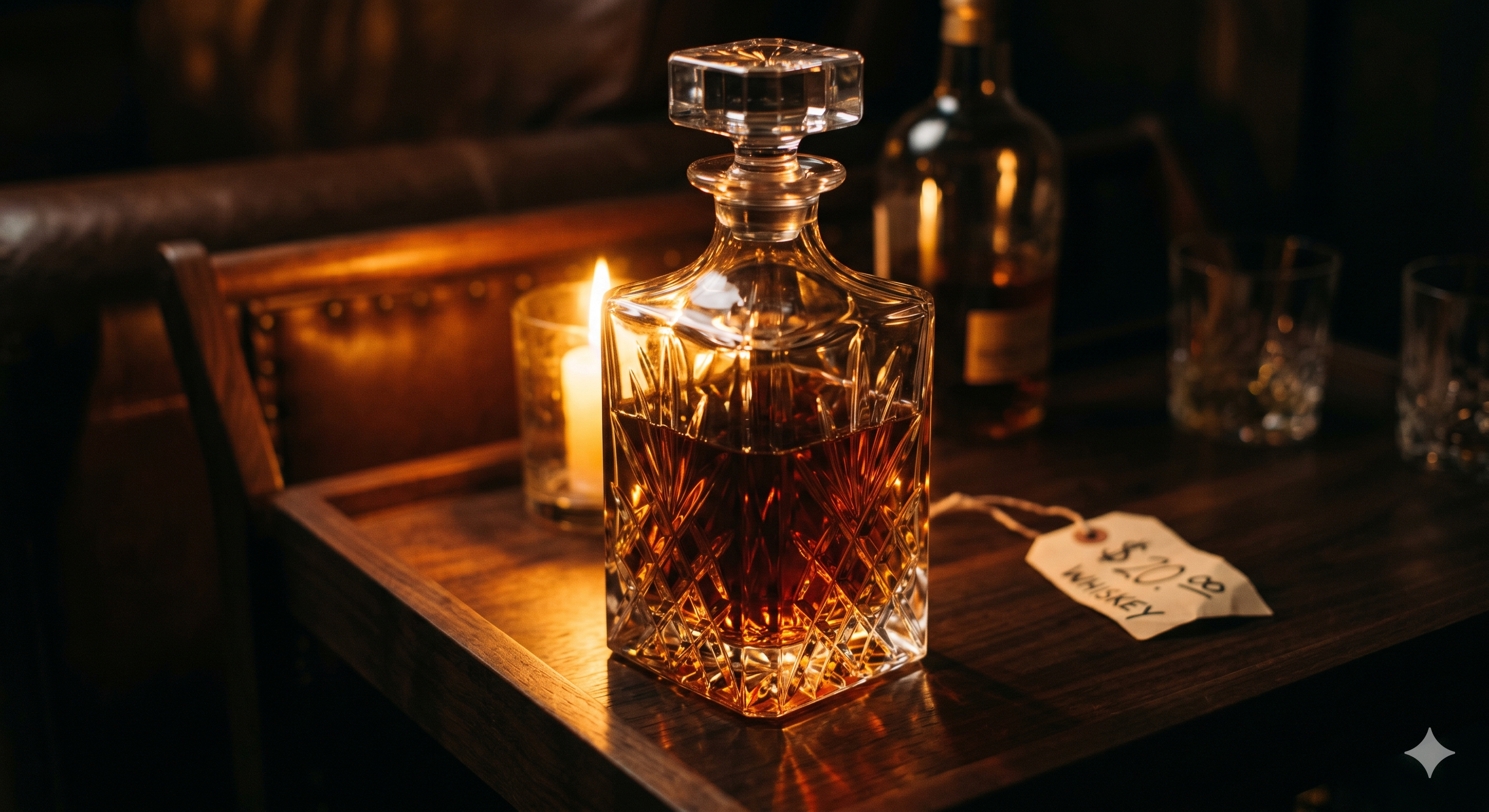
Now picture this instead: cheap whiskey in a decanter — a $20 bottle of decent bourbon sitting in hand-weighted crystal on your bar cart like it earned its place there. Same whiskey. Different world.
This isn't a trick for cheapskates. It's what whiskey enthusiasts actually do — and the psychology behind why it works is backed by consumer research, not internet folklore. By the end of this, you'll understand exactly why presentation outperforms price in the whiskey moment, what to look for in a decanter that makes the effect real, and the one thing that can ruin the whole setup.
The Whiskey Truth That Sommeliers Already Know
Here's what the whiskey world quietly agrees on: decanters don't improve the liquid. Multiple expert sources confirm that whiskey decanters 'will not enhance nor detract from aroma or flavour' (Jameson Whiskey, 2023). The Reddit whiskey community says it even more plainly — 'the goal of a decanter is to have something look cooler.'

That sounds like an argument against them. It's actually the argument for them.
Because when you're hosting, gifting, or building an evening around a pour, the moment isn't about the molecular composition of the spirit. It's about what the experience communicates — to your guests, to yourself, and to the person receiving the glass. We explored the science of this in detail in Does a Whiskey Decanter Change the Taste? — and the short answer might surprise you.
This is the same principle that drives the entire premium restaurant industry. A $12 wine poured with intention, from a proper carafe, at a candlelit table, outperforms a $40 wine handed to you in a plastic cup at a ballgame. The liquid hasn't changed. The experience has changed everything around it.
Why a $20 Bottle Performs Better in a Decanter Than a $60 Bottle on a Table
The research on this is consistent across consumer psychology, gifting studies, and whiskey enthusiast communities.

Three mechanisms explain the effect.
1. The Vessel Signals Quality, Not the Label
When a guest sees a decanter on a bar cart, their brain performs an instant quality assessment and the decanter wins every time. The weight, the clarity of the glass, the way light moves through it these are physical cues that register as premium before a single sip is taken.
An expensive bottle still comes in factory packaging designed for shelf appeal, not experience appeal. The label says 'quality.' A quality decanter shows it.
2. Ritual Transforms Consumption Into Experience
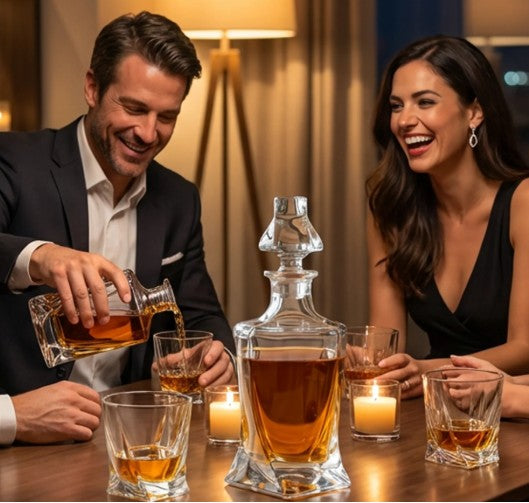
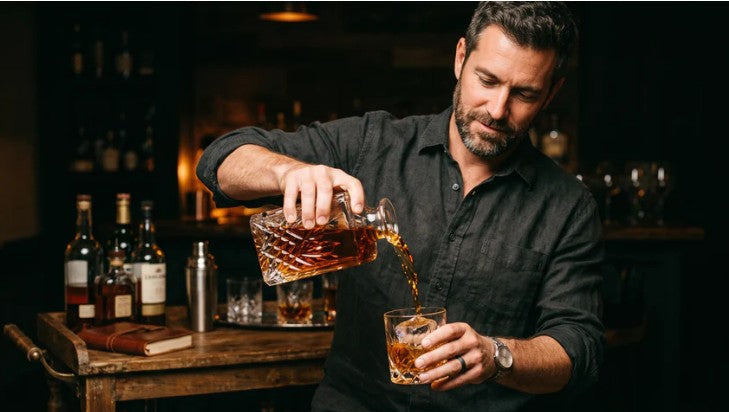
When you pour from a decanter, the movement itself is intentional. The heft of the glass, the unhurried pour, the amber catching the light — these aren't accidents. They're the ceremony. And ceremony changes how everything tastes.
3. Your Guests Never See the Price Tag
This is the part nobody says out loud. When a $60 bottle sits on your table in its original packaging, guests have a price reference point. They know what they're looking at. When that same $20 bourbon sits in a premium decanter, the only reference point is the decanter itself — and if the decanter is right, the reference point is 'this person takes this seriously.'
Whiskey enthusiasts who understand this principle fill their decanters with what they call 'shelf whiskey' specifically because they know the decanter carries the visual weight.
The One Thing That Destroys the Effect
There's a version of this trick that backfires badly, and it's worth understanding before you invest in any decanter.
The effect only works if the decanter is credible. Light glass that wobbles when you pick it up, a stopper that sits loose or drips on the pour, any ambiguity about whether the crystal is lead-free — these aren't minor inconveniences. They're the signal that reverses everything the ritual was supposed to communicate.
A cheap decanter does more damage than no decanter at all. The moment someone picks it up and feels the lightness, or notices the stopper rattle, or wonders silently whether lead crystal is safe — the ceremony collapses. You've swapped one problem (ordinary bottle) for a worse one (performative cheap).
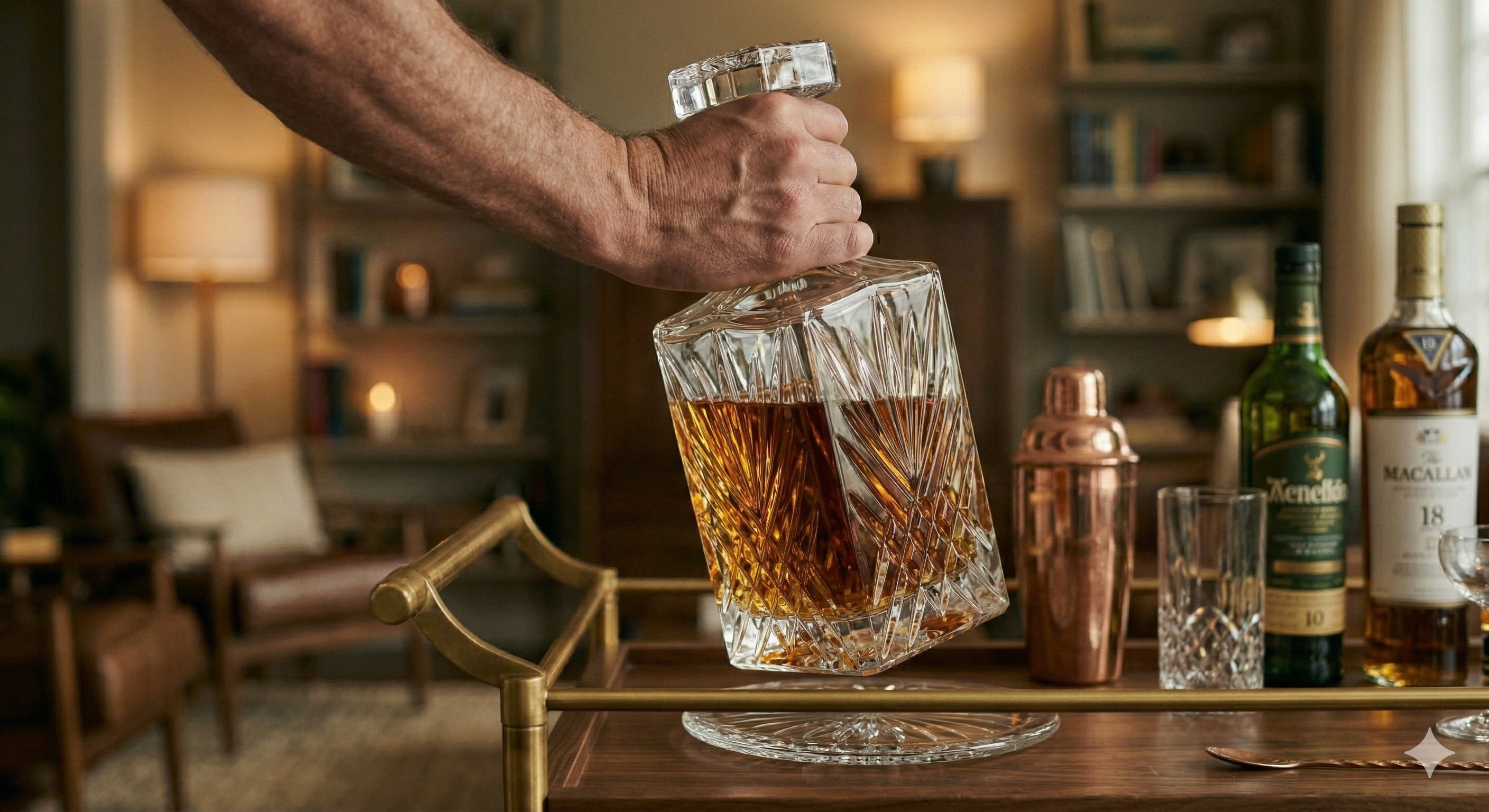
This is why weight and heft are the non-negotiable quality signals in this category. Before anything else, the decanter has to feel like it means it.
What Whiskey Enthusiasts Actually Put in Their Decanters
The whiskey community has developed a clear set of practical rules around decanter use that most brands never talk about. Understanding them helps you get the most from the setup.
For Display and Hosting: Use Everyday Bourbon
Experienced enthusiasts consistently recommend filling your display decanter with quality everyday bourbon — your Evan Williams, your Buffalo Trace, your Four Roses Yellow Label. These are excellent whiskeys at $20–$30 that punch well above their price in a proper vessel. The decanter elevates them. Putting a $150 single malt in a display decanter, by contrast, exposes it to light and air it doesn't need.
For the Infinity Bottle: Use Finishing Pours
The infinity bottle is one of the whiskey community's most engaging practices — and it's built for decanters. As each bottle approaches empty, the last one to two ounces goes into a single decanter that accumulates into a continuously evolving personal blend. Enthusiasts describe their infinity bottles as 'living histories' of their whiskey journey, with some running four-plus years and sixty-plus bottles deep. The decanter here isn't decoration. It's a project. Here's how to start one.
For Gifting: The Decanter Is the Gift
When a decanter is the gift, the whiskey inside it matters less than what the whole package communicates. A premium decanter set delivered in proper presentation packaging, with the heft and clarity that signals quality, tells the recipient: 'You were worth the effort.' The bottle someone fills it with later becomes part of their story, not the story itself. Browse the Hydro Gizmos luxury decanter collection — every set is built with gifting confidence as the design brief.
How to Choose a Decanter That Makes This Work
The decanter is doing the heavy lifting in this equation. These are the criteria that separate a setup that elevates the experience from one that exposes it.
Weight and heft. The single most immediate quality signal. Pick it up before you decide. If it feels light, it will communicate light. There is no workaround.
Lead-free certification. This is non-negotiable. Lead crystal leaches into spirits stored over time — a fact well-documented in whiskey communities. Any decanter worth using must carry explicit lead-free verification, not just implication. Here's what to look for.
Stopper seal and pour quality. A loose stopper or a dripping pour immediately breaks the ceremony. The stopper should seat firmly, the pour should be controlled, and neither should require concentration to manage.
Capacity. A full 750ml bottle should fit. Discovering the decanter holds 700ml is an avoidable frustration.
Presentation packaging. Whether you're gifting or keeping it, the unboxing matters. A decanter that arrives in quality packaging sets the tone before it's even seen.
For a deeper breakdown of how to evaluate any decanter against these standards, read: What Makes a Good Whiskey Decanter.
Frequently Asked Questions
Does a decanter actually improve whiskey?
No — and that's the point. Decanters don't alter the chemistry of whiskey. What they do is transform the experience around it. The weight, clarity, and ritual of pouring from a quality decanter changes how the moment feels, which changes how the whiskey registers. The experience is better. The whiskey is the same.
What whiskey should I put in a decanter?
For display and hosting, everyday bourbon in the $20–$35 range is the practical choice. Quality whiskeys like Buffalo Trace, Evan Williams Black Label, or Four Roses Yellow Label perform excellently in a quality vessel. For premium single malts or limited releases, keep them in the original bottle — controlled storage matters more than aesthetics for those.
Is it OK to put cheap whiskey in a crystal decanter?
Entirely fine — and genuinely recommended. Lead-free crystal does not affect the spirit, so the only consideration is how long it sits. For everyday use and hosting, refilling your decanter weekly with a quality everyday bourbon is exactly how enthusiasts use these pieces. The decanter does the work. The whiskey just needs to be decent.
Does expensive whiskey matter if it's in a decanter?
Less than you'd think, for the moment experience. The presentation effect is driven by the decanter, not by what's in it. That said, if you're hosting a tasting or serving a whiskey specifically for its character and complexity, pour from the original bottle so guests can see and discuss what they're drinking. Use the decanter for the ritual pour, the bar cart centerpiece, and the everyday host moment.
The Moment Is What People Remember
Nobody remembers the price tag of what they drank at a dinner party. They remember how the evening felt the weight of the glass in their hand, the amber in the light, the host who clearly gave a damn about the details.
A $20 bottle in the right decanter creates that memory. A $60 bottle in the original packaging, beside a pile of bottle caps on a kitchen counter, often doesn't. The trick isn't in the whiskey. It's in understanding that the ritual is the product — and the decanter is what makes the ritual credible.
Get the decanter right, and everything else follows.
|
YOUR $20 WHISKEY DESERVES A $200 MOMENT The Hydro Gizmos Decanter Set is lead-free, hand-weighted, and built to make every pour feel like an occasion — whatever's inside. |
Share:
Infinity Bottle: What to Do With the Last Pour of Every Whiskey You Love
How to Clean a Whiskey Decanter Properly (Without Ruining It)