
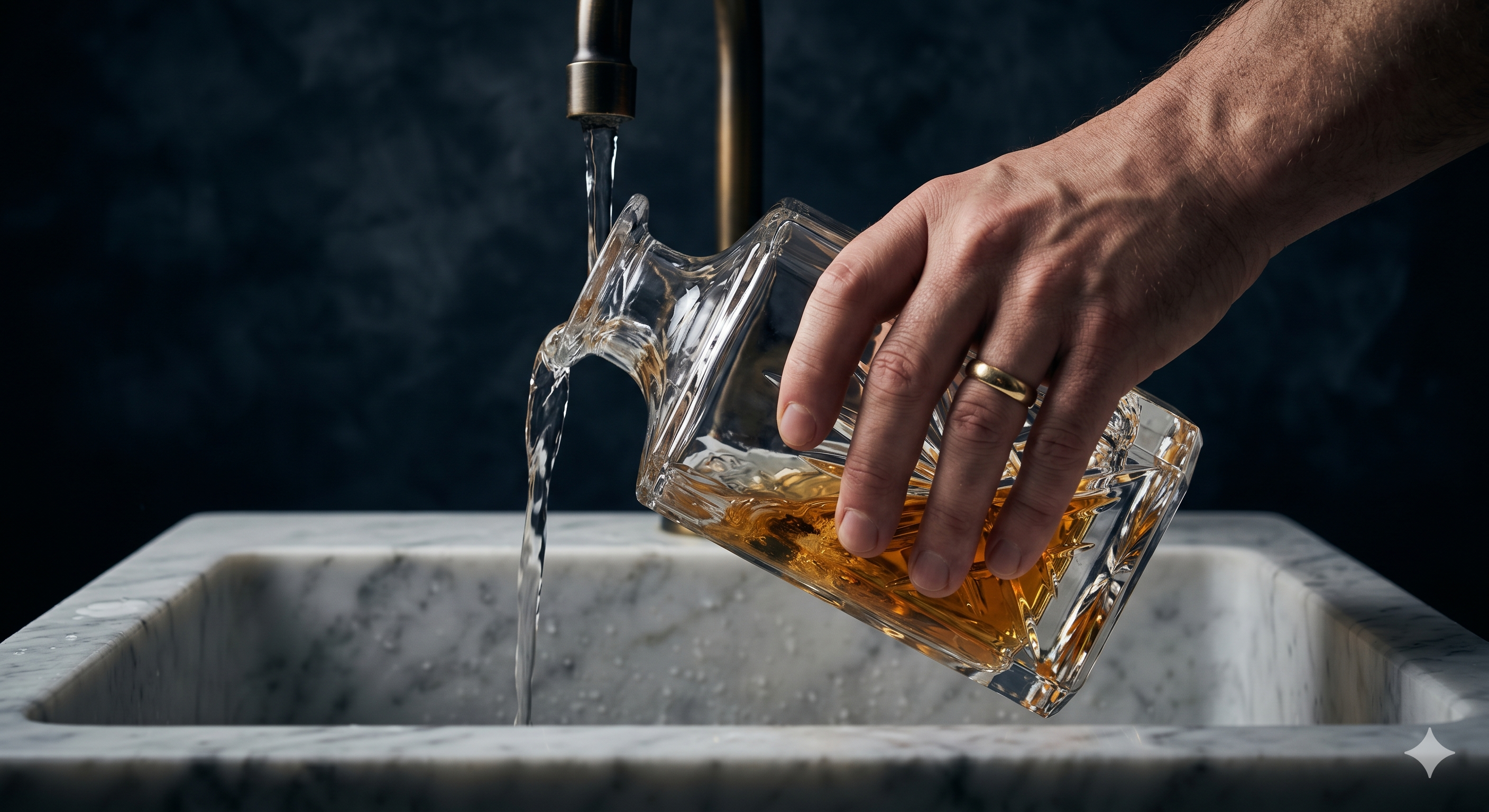
That amber film clinging to the inside of your decanter? It's not a badge of character. It's whiskey residue — and if you leave it long enough, it starts to affect every pour that follows it.
The problem isn't that people don't clean their decanters. The problem is that most people clean them the wrong way. Dish soap leaves a residue that kills the nose of your next dram. Bottle brushes scratch glass-on-glass surfaces. Hot water can crack thin crystal. And if you skip drying completely, you're inviting mould into a vessel you paid good money for.
By the end of this guide, you'll know exactly how to clean a whiskey decanter — whether it's a narrow-neck globe, a wide-mouth diamond cut, or a twisted design — without damaging the glass, the stopper, or the seal. You'll also know what to do about stubborn stains, how often to clean, and the single most important step almost everyone skips.
If you're thinking about gifting a decanter this season, start with what actually separates a quality decanter from a cheap one — or browse the full Hydro Gizmos collection — because how easy something is to clean is one of the clearest signals of build quality.
Why Cleaning a Whiskey Decanter Is Different from Cleaning Other Glassware
A whiskey decanter is not a pint glass. Standard dishwasher cycles, dish soap, and abrasive sponges are genuinely damaging — not overcautious advice.
The interior of a quality lead-free crystal or glass decanter has a smooth, non-porous surface that retains flavour compounds from whatever whiskey sits inside it. Detergent residue doesn't rinse away cleanly — it bonds to the surface and imparts a soapy, flat quality to the next spirit you pour. The Scotch Whisky Association's guidance on glassware consistently emphasises rinsing with clean water over soap use for nosing and tasting vessels, and the same logic applies directly here.
Glass-on-glass stoppers — found on most premium decanters — are ground to fit a specific neck. Harsh scrubbing around the stopper seat can introduce micro-abrasions that compromise the seal over time. That matters because a well-fitted stopper is the single most important functional feature of a good decanter: it protects your whiskey from oxidation and alcohol evaporation. If you have questions about lead content and material safety, our guide to whether whiskey decanters are safe covers exactly what to look for.
The short version: treat your decanter like fine glassware, not like a sports bottle.
What You'll Need Before You Start
You don't need specialist equipment. Most of what makes decanter cleaning effective is what you choose not to use.
For routine cleaning after each use, you'll need warm (not hot) water and patience. That's genuinely it. For a deeper clean after a long period of use — or when you notice a haze or whiskey film — add one of the following:
• White vinegar: A 50/50 solution with warm water dissolves mineral deposits and whiskey film without leaving residue. Rinse thoroughly after.
• Uncooked rice or coarse sea salt + water: The mildly abrasive action of dry rice or salt swirled inside the decanter dislodges residue without scratching the glass. This is the most widely recommended method in whiskey enthusiast communities.
• Specialist decanter cleaning beads: Small stainless steel balls designed specifically for this job. Highly effective for globe or narrow-neck designs where a brush can't reach.
• Denture cleaning tablets or bicarbonate of soda: Effective for mineral staining. Drop one tablet into warm water inside the decanter, let it fizz for 20–30 minutes, then rinse.
Avoid dish soap entirely for the interior. Avoid bottle brushes on crystal or hand-blown glass (fine for thick, wide-mouth designs only). Never use bleach.
💡 PRO TIP The most common mistake whiskey drinkers make is using too much heat. Hot water doesn't clean a decanter faster — it risks thermal shock, especially on crystal, and can loosen the stopper fit over time. Warm water is always the right call.
How to Clean a Whiskey Decanter: Step-by-Step
This method works for globe decanters, diamond-cut designs, twisted decanters, and standard decanters alike.

Step 1: Empty and Rinse Immediately
1. As soon as your decanter is empty, rinse it with warm water. This is the most important step of all. Whiskey residue is easy to remove when fresh and can become a stubborn amber film if left to dry out. Swirl the water around for 10–15 seconds, then pour it out. Repeat once.
Step 2: Choose Your Cleaning Method Based on Residue Level
For light residue (regular cleaning after each use):
1. Fill one-third of the decanter with warm water. Swirl firmly for 30 seconds. Pour out. Repeat twice, then leave upside down on a clean drying rack to air dry completely — minimum 30 minutes, ideally overnight.
For moderate residue (cloudy glass, light haze):
• Fill with a 50/50 warm water and white vinegar solution.
• Let it sit for 15–20 minutes.
• Swirl, pour out, and rinse three times with clean warm water.
• Air dry upside down.
For heavy staining (dark residue, old whiskey film):
• Add two tablespoons of coarse sea salt (or a handful of uncooked rice) and a small amount of warm water — just enough to move freely.
• Swirl the mixture firmly for 2–3 minutes. The grain acts as a gentle, non-scratch abrasive.
• Pour out, rinse thoroughly three times.
• If staining persists, follow with a white vinegar soak before the final rinse.
💡 PRO TIP For globe decanters or other narrow-neck designs, swirling is your primary cleaning motion — brushes won't reach the widest part of the vessel. The rice method is especially effective here. If you own a decanter with steel cleaning beads in the box, this is the moment to use them.
Step 3: Clean the Stopper Separately
The stopper requires its own attention. Remove it from the neck and wipe it down with a clean, damp cloth. If there's residue around the ground glass fitting, use a cotton bud lightly dampened with white vinegar. Dry the stopper thoroughly before reinserting — trapping moisture between stopper and neck creates the exact conditions for mineral deposit build-up.
Step 4: Dry Completely — This Step Cannot Be Rushed
Incomplete drying is the cause of almost every mould or mildew issue people report with decanters. Place the decanter upside down on a drying rack or prop it at an angle on a clean towel — the goal is airflow through the neck. Leave it for a minimum of 30 minutes. Overnight is better. A decanter stored while still damp, especially with the stopper inserted, traps moisture and becomes a problem.
Never use a cloth to dry the inside. It introduces fibres and can leave lint behind, which shows up clearly in the next pour.
How Often Should You Clean a Whiskey Decanter?
The honest answer from the whiskey community: after every use, or at the very least every time you empty it.
If your decanter is purely on display and empty, rinse it with warm water every four to six weeks to prevent dust and airborne particles from settling on the interior surface. If it's actively in use and holds whiskey regularly, a warm water rinse after each refill keeps the cycle clean.
A deep clean with vinegar or rice is typically needed every two to three months for a decanter in regular use, or whenever you notice any cloudiness or residue build-up.
Storing whiskey in a decanter long-term — meaning weeks or months — is a separate topic. The short answer: a high-quality lead-free decanter with a tight stopper is fine for medium-term storage (up to a few months), but the original bottle remains the better long-term option. For a full breakdown, see whiskey decanter vs original bottle: which is actually better for storage. The decanter is a ritual object and a display piece — built for the pleasure of pouring, not indefinite cellaring.
How to Remove Stubborn Stains and Cloudy Glass
Cloudiness inside a whiskey decanter typically comes from one of two sources: mineral deposits left by hard water, or a thin film of oxidised whiskey residue. Both respond well to acid — and white vinegar is the easiest acid to use safely.
For Mineral Deposits (White or Milky Haze)
• Fill the decanter with undiluted white vinegar and leave it for 30 minutes to an hour.
• Swirl, pour out, and rinse five times with warm water.
• If cloudiness remains, repeat the soak and extend to two hours.
For Whiskey Film (Amber Residue, Dark Staining)
• Use the rice or salt method described in Section 3.
• Follow with a vinegar soak if the mechanical abrasion alone doesn't fully clear it.
• For particularly stubborn staining: drop a denture cleaning tablet into warm water inside the decanter. The effervescent action reaches corners and curves that swirling can't. Leave for 30 minutes, then rinse thoroughly.
Very old, set-in staining from a decanter that was stored filled with whiskey for a long period may take two or three cleaning cycles to fully remove. Patience and multiple rounds of the vinegar method will clear almost anything.
If you receive a new decanter as a gift — such as one of the personalised engraved sets — rinse it with warm water before the first use regardless of how clean it looks. The same applies to gift sets for bosses and colleagues. Dust, packaging residue, and handling all leave traces inside. One good rinse sets you up right from the first pour.
Cleaning Specific Decanter Shapes
The cleaning method stays consistent, but the technique adapts slightly to the design. If you're unsure which shape you own or are considering — globe, diamond, twisted, or fashion — our whiskey decanter shapes guide covers each one in detail.

Globe Decanter
Globe and sphere decanters have wide interiors and narrow necks — ideal for the swirling method. Use the rice or salt technique with enough water to create movement inside the globe. Cleaning beads work exceptionally well here. Drying requires more patience because airflow through the narrow neck is limited; prop it at an angle to encourage drainage. See The Globe decanter set →
Diamond-Cut Decanter
The faceted cuts on a diamond decanter are external — they don't complicate cleaning. The interior is smooth. Standard warm water and vinegar methods apply. Take care around the base where the cut pattern meets the flat bottom, as sediment can occasionally collect there. See The Diamond decanter set →
Twisted Decanter
The aesthetic twist is in the body of the glass, not the interior channel. The inside is a standard cylindrical shape and cleans like any other decanter. The stopper on twisted designs often sits in a wide neck — wipe the ground glass fitting thoroughly and dry before reinserting. See The Twisted decanter set →
Wide-Mouth / Fashion Decanter
Wide-mouth designs are the easiest to clean — a decanter brush can be used here if you prefer, but warm water swirling still works. The wider opening also dries faster, so drying time is less of a concern. See The Fashion decanter set →
Frequently Asked Questions
Can you put a whiskey decanter in the dishwasher?
No. A dishwasher will damage most decanters. The high heat can cause thermal shock in crystal, the detergent leaves residue on the interior, and the mechanical action risks the stopper. Hand washing with warm water is always the correct method.
How do you get residue out of a narrow-neck decanter?
Add two tablespoons of coarse salt or uncooked rice and a small amount of warm water, then swirl firmly for two to three minutes. This dislodges residue without scratching. Follow with three rinses of clean warm water. For persistent residue, a white vinegar soak works well on its own or as a follow-up.
How do you dry the inside of a whiskey decanter?
Place it upside down on a drying rack with the neck pointing down to allow airflow. Leave it for at least 30 minutes — overnight is better. Never insert the stopper until the interior is fully dry. A cloth cannot safely dry the inside; air drying is the only method that works without leaving fibres.
How long can you leave whiskey in a decanter?
A lead-free decanter with a well-fitted stopper can hold whiskey safely for up to two to three months without significant loss of quality. Beyond that, gradual alcohol evaporation and oxidation begin to affect the flavour. If you want to understand exactly what happens to whiskey inside a decanter over time, does a whiskey decanter change the taste covers it in full. For long-term storage, the original bottle is the better option. The decanter is built for display, ritual, and the pleasure of pouring — not indefinite cellaring.
Is it safe to put whiskey in a crystal decanter?
Yes, if the decanter is certified lead-free crystal. Traditional crystal contains lead oxide, which can leach into spirits over extended contact. Modern lead-free crystal — the standard for any quality decanter sold today — is completely safe. Always check that lead-free status is explicitly confirmed by the manufacturer.
What's the best way to clean a globe whiskey decanter?
The swirling method with rice or coarse salt is the most effective for globe decanters because it allows cleaning of the wide interior through the narrow neck. Use enough warm water to create movement, swirl firmly, and follow with three rinses of clean warm water. Globe decanters need slightly longer to dry due to the narrow neck — prop upright and inverted at an angle for airflow.
Where Legends Unwind — And Where Clean Glass Makes It Count
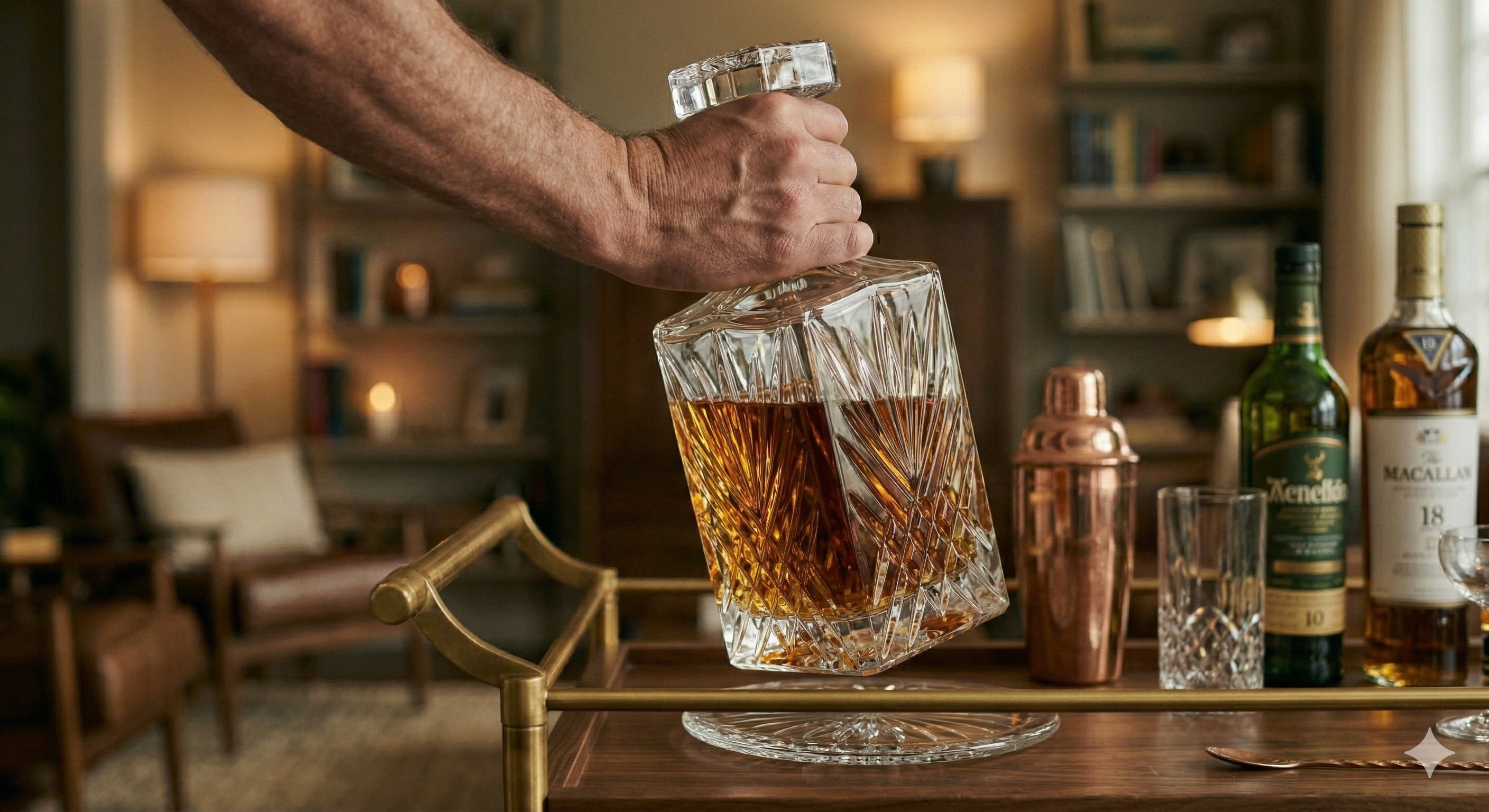
A whiskey decanter is not a passive object. It's the first thing your guests see when they walk into the room. It's the centrepiece of your bar cart. It's the object you pour from when the occasion deserves something more than lifting a bottle.
Keeping it clean — genuinely clean, not just visually clear — is what ensures every pour tastes the way it should. Warm water after each use. White vinegar when residue builds up. Complete drying before the stopper goes back in. These three habits are the entire maintenance routine.
The decanter you own should work as hard as the whiskey inside it. If yours is frustrating to clean, too narrow to reach, or cloudy after a few months of use, that's a design problem — not a whiskey problem.
Your Decanter Deserves the Best
Every Hydro Gizmos decanter is 100% lead-free, built with a precision-fit stopper, and designed to become the centrepiece of your bar cart — not a source of anxiety.
Browse The Full Collection → HydroGizmos.com
Questions? Visit our About page or get in touch.


Share:
The Cheap Whiskey Trick: Why a $20 Bottle in a Decanter Beats a $60 Bottle on the Table
Big Ice vs. Whiskey Stones vs. Regular Ice: What Actually Belongs in Your Glass