

You started an infinity bottle because the idea made sense: the last pour of every bottle, combined, building into something that's entirely yours. Then you added that Islay Scotch. The one with the bonfire smoke and the sea salt. And now everything tastes like a campfire.
You're not the first. Across thousands of Reddit threads, forum discussions, and enthusiast communities, the same infinity bottle mistakes surface again and again — not because people don't care, but because no one told them the rules before they started. The concept sounds simple. The execution has real traps.
The six most common infinity bottle mistakes are: adding peated whiskey to a non-peated blend, starting with a whiskey you don't actually like, adding too much at once, using the wrong vessel, letting the bottle run too low, and ignoring oxidation. Fix them before they compound because once your blend is off, there is no reset button.
This guide covers the six errors that wreck blends, waste good whiskey, and turn a satisfying ritual into a frustrating one. Each has a direct fix. None require starting over unless you've already hit Mistake #1.
Mistake #1: Adding a Peated Whiskey to a Non-Peated Blend
This is the most reported blend-wrecker in enthusiast communities, and it's irreversible. Peated Scotch — any whiskey with significant smoke character from peat-fired malt — doesn't blend into a neutral background. It overwhelms it. A single 2-ounce pour of a heavily peated Islay malt can fundamentally and permanently alter the flavour profile of an entire infinity bottle.

The chemistry is straightforward: phenolic compounds responsible for smoke character don't dissipate or balance out over time. They accumulate. What starts as a background note becomes the dominant feature, then the only feature.
The fix: Run two separate infinity bottles if you drink both peated and non-peated whisky. One for your smoky expressions — Laphroaig, Ardbeg, Caol Ila and their kin. One for everything else. This isn't extra effort. It's the difference between a blend that evolves and one that fossilises.
This is also the reason to taste your blend after every addition, not just occasionally. Catching early drift gives you a chance to counterbalance with something neutral before the smoke sets in completely.
Mistake #2: Starting with a Whiskey You Don't Actually Enjoy
The foundation of an infinity bottle matters more than any subsequent addition. Whatever you pour in first becomes the DNA of the blend — its baseline character is present in every pour for as long as the bottle exists. If that foundation has a flaw you don't like, that flaw doesn't disappear as you add more whiskey. It persists, diluted but present, running through the whole blend like a thread you can't pull out.
Community wisdom is consistent on this point: start with something you genuinely enjoy drinking neat. Not something you're trying to use up. Not a bottle that was a gift you didn't love. Your infinity bottle inherits whatever you put in first, and no subsequent addition fully erases it.
The fix: Begin with 3–4 ounces of a balanced, enjoyable everyday whiskey — something with no strong single characteristic that might dominate. A clean bourbon or a gentle blended Scotch works well. Think of it as setting a neutral stage for every bottle that follows.
If you want to follow the right ritual from the first pour, read our guide on what to do with the last pour of a bottle — it walks through the full starting approach.
Mistake #3: Adding Too Much at Once
The infinity bottle concept works through gradual accumulation. Small additions — 1 to 2 ounces — allow the blend to absorb and integrate new character. Large additions disrupt the balance you've built, introduce sudden flavour swings, and can pull the blend in a direction that takes months to correct.
Experienced practitioners add from bottles as they near the end: a pour or two when a bottle hits its final measure. That quantity is small enough to add complexity without destabilising the existing blend. When someone pours in half a bottle of something bold, the blend often has to be rebuilt from scratch by adding large quantities of neutral spirit — which defeats the point entirely.
The fix: Set a personal rule: no single addition exceeds 2 ounces unless you've tasted the blend and specifically want to pull it in a particular direction. Treat contributions like seasoning. A little goes a long way. More can always be added. It cannot be taken out. Start with any whiskey you genuinely enjoy — the blend rewards honesty about what you actually drink.
Mistake #4: Using the Wrong Vessel
Most people start their infinity bottle in a repurposed whiskey bottle. This is functional but creates friction over time. The narrow neck makes pouring in contributions messy. The tall shape is harder to nose properly. And a standard bottle offers no information about how much is inside without lifting and eyeballing.
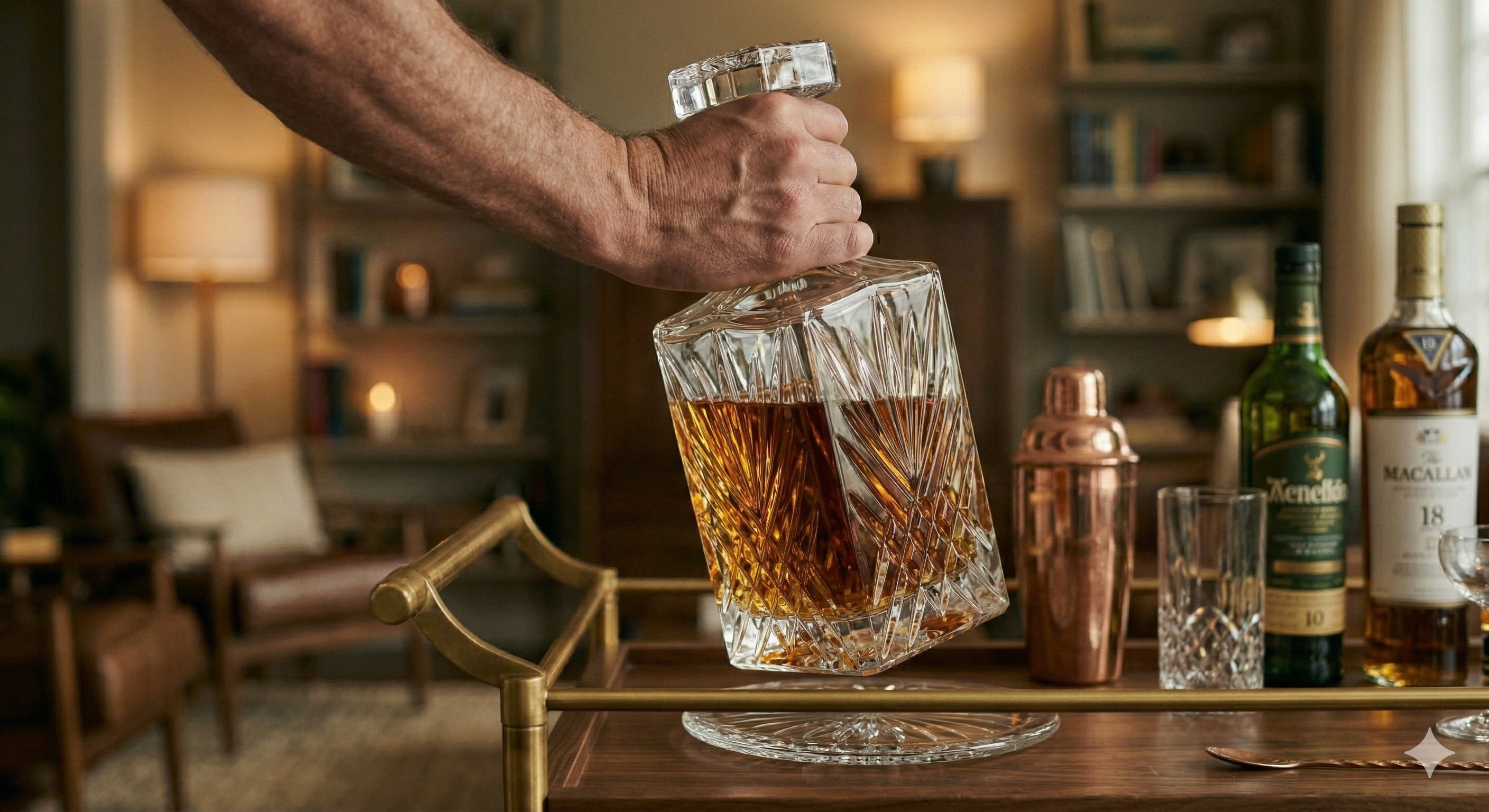
There's a more practical and visually compelling alternative. A wide-mouth decanter with a quality stopper solves all three problems: easier to contribute to, easier to nose, and visible at a glance. The wide mouth also means you can actually smell the blend as it evolves — which is most of the point.

The vessel also signals intent. A repurposed bottle on a shelf reads as improvised. A decanter reads as deliberate — something placed there because it deserves to be seen.
The fix: Move your blend to a proper decanter once it reaches a volume worth committing to. Look for a vessel with a wide mouth, a tight seal, and enough capacity to hold contributions from a dozen or more bottles. A decanter built for this puts the blend on display rather than hiding it.
One note that matters in 2026: verify that any decanter you use is explicitly lead-free. Traditional lead crystal was widely used in older decanters and leaches into spirits over time. Any serious infinity bottle deserves a vessel you trust completely.
Mistake #5: Letting the Bottle Run Too Low
Headspace is the enemy of an infinity bottle. When the liquid level drops below roughly 25 percent of the vessel's capacity, the ratio of air to liquid increases significantly — and that air drives oxidation. Whiskey oxidation over extended periods flattens the flavour profile, dulling both high and low notes, leaving something that tastes like a version of itself with the contrast turned down.
This is the same principle behind why a half-empty bottle of whiskey tastes slightly different after six months than when it was newly opened. The chemistry isn't dramatic on a short timeline, but an infinity bottle is often a long-term project measured in years. Letting it run low repeatedly accelerates that flattening.
The fix: Refill when the blend drops to roughly 50 percent capacity. Not when it's nearly empty. This keeps headspace manageable and gives you a consistent reference point for how long whiskey keeps in a decanter before the flavour impact becomes noticeable.
Mistake #6: Using a Decanter Without Verifying It's Lead-Free
This mistake is less visible than the others — which is exactly what makes it worth taking seriously. Lead crystal decanters were standard barware through most of the twentieth century. They were prized for their weight, clarity, and the way they caught light. They were also slowly leaching lead into whatever spirits they held.
Lead migration into spirits is time-dependent and concentration-dependent. A single pour from a lead crystal decanter carries minimal risk. Storing whiskey in one for weeks or months — as an infinity bottle owner inevitably will — raises the exposure meaningfully. The US FDA has recommended against using lead crystal for long-term spirit storage for this reason.
The fix: Choose only lead-free borosilicate glass or lead-free crystal for your infinity bottle. This isn't a marketing qualifier — it's a verifiable material specification. If a decanter's product description doesn't explicitly confirm lead-free construction, treat that absence as an answer. The whiskey you're building deserves a vessel that's safe for the long term.
What a Good Infinity Bottle Looks Like After a Year
When the six mistakes above are avoided, an infinity bottle does something genuinely compelling: it develops a character that belongs to no single distillery, no single region, no single year. Each contribution adds a layer that neither dominates nor disappears. The blend becomes a record — of your tastes, your discoveries, the bottles you finished and the ones you savoured.
Some enthusiasts maintain separate infinities for different whiskey families — one for bourbon and American whiskey, one for Scotch, one for world whiskeys. Others keep a single evolving blend that reflects everything they drink. Both approaches work. The variables that determine success are the same: the right start, the right additions, the right vessel, and enough patience to let the blend find itself.
The decanter you choose for this matters more than it might seem. Weight tells you something about the glass. A quality stopper tells you something about the seal. Lead-free construction tells you the maker understood what the vessel would actually be used for. These aren't luxury considerations. They're basic requirements for a project that's meant to last.
Your Infinity Bottle Deserves a Proper Home
The right decanter makes the whole ritual work — wide mouth for easy contributions, a tight seal to protect the blend, lead-free glass you can trust for the long term, and a design that earns its place on the bar cart.
→ Shop the Hydro Gizmos Decanter Set


Share:
Why He'll Actually Keep This One: How to Choose a Whiskey Gift for Men
10 Whiskey Gifts for Men That Feel Thoughtful, Not Generic