
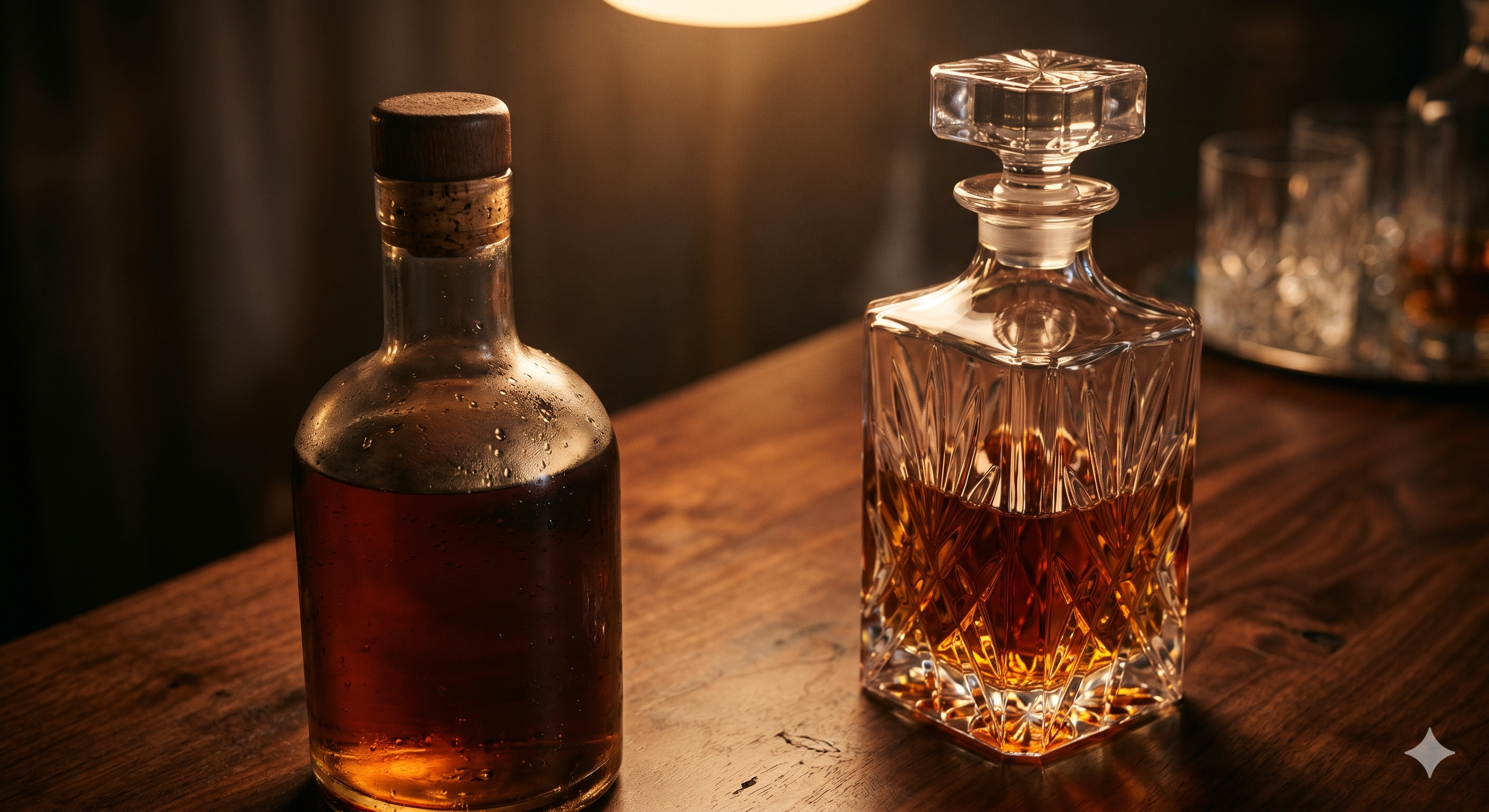
You have a nice bottle of single malt. You also have a beautifully shaped crystal decanter sitting on your bar cart, catching the light, waiting to be filled. The question comes up every time you look at both of them together: should you transfer the whiskey or leave it where it is?
It seems like a simple question. Most of the advice online picks a side and sticks to it. Some say decanters are purely decorative and will ruin your whiskey if you use them for storage. Others say they are essential for a proper home bar and enhance the experience. Very few give you the actual decision framework, covering the specific conditions under which one choice is clearly better than the other.
This post does exactly that. By the end, you will know precisely when a decanter is the right call, when the original bottle protects your whiskey better, and how to get the most out of whichever vessel you choose.
The Short Answer: Decanter vs Bottle for Whiskey Storage
You should transfer whiskey into a decanter when you plan to finish the bottle within four to six weeks, are serving guests, or want to display the spirit on a home bar. For long-term storage beyond six weeks, or for a rare or aged expression you want to protect, keep the whiskey in its original bottle with the cap sealed tight.
Here is everything this post covers:
-
Oxidation and headspace: Why the original bottle's narrow neck is a preservation advantage most drinkers overlook.
-
When transferring makes sense: The four specific situations where a decanter genuinely earns its place.
-
When the original bottle wins: The storage scenarios where decanting will cost you flavor.
-
How seal quality changes everything: Why the stopper on your decanter matters more than its shape or material.
-
Lead-free vs leaded crystal: What the difference means for short-term serving vs longer storage.
-
Decanter maintenance: How to clean and prepare a decanter so it does not affect what you pour into it.
-
Decanters as gifts: Why engraved and personalized sets occupy a completely different category from functional storage.
-
What to look for when buying: The three non-negotiable features of a decanter worth owning.
1. Why the Original Bottle Has a Built-In Preservation Advantage
What it means: The original whiskey bottle is not just packaging. It is a purpose-built preservation vessel with a geometry and seal designed specifically to slow oxidation from the moment the bottle leaves the distillery.
Why it matters for flavor: Oxidation is the primary threat to an opened whiskey bottle. Once air enters the bottle, slow chemical changes begin. Executive bourbon steward Chris Blatner explains that slow oxidation can dull aromas and flatten flavor over time, and while whiskey does not spoil the way wine does, it can lose vibrancy, especially once a bottle contains more air than liquid.

The original bottle fights this in a way most decanters cannot match. Its narrow neck keeps the liquid surface area small, which limits how much oxygen touches the whiskey at any given moment. A full 750 mL bottle has barely 5% of its internal volume as headspace. That is a tiny amount of oxygen in contact with the spirit. Now picture what happens when that same whiskey moves into a wide-shouldered decanter.
The headspace triples or quadruples. Oxygen exposure goes up dramatically. And most decorative decanters use glass or ground-crystal stoppers that do not achieve anywhere near the airtight seal of a factory cork or screw cap. That gap in seal performance, compounded over weeks, is where flavor loss happens.
In our experience reviewing decanter designs and seal integrity, the ones that look the most impressive, including heavy cut crystal with faceted stoppers, are frequently the worst performers when it comes to keeping air out. The stopper sits beautifully in the neck and leaks gently, constantly.
A practical self-audit you can run right now: hold your decanter stopper up to a light source and look at the contact edge. If you can see light passing around the rim, the seal is imperfect. Compare that to the screw cap on your whiskey bottle, which compresses against a liner and creates a near-hermetic barrier.
The Hydro Gizmos approach: Every decanter in the luxury whiskey decanter sets collection at Hydro Gizmos is selected with stopper fit as a primary quality criterion, not an afterthought. The difference between a stopper that looks airtight and one that actually is airtight is the difference between whiskey that tastes sharp at week six and whiskey that has already gone flat.
2. When Transferring to a Decanter Is the Right Call
What it means: A decanter earns its place in specific, well-defined circumstances. Outside of those circumstances, the original bottle is the better vessel. Inside them, a decanter is genuinely superior.
The four situations where transferring makes sense:
You are entertaining within the next four to six weeks. If the whiskey will be gone before oxidation becomes a meaningful issue, the presentation and convenience advantages of a decanter far outweigh the minimal preservation risk. Pouring from a heavy crystal decanter for guests is a different experience from passing around the original bottle. There is a reason every serious home bar has at least one.
The original bottle is less than a third full. This is the scenario where a transfer actually protects the whiskey. Bourbon expert Chris Blatner recommends transferring whiskey into a smaller container once you have consumed about two thirds of the bottle, because a nearly empty bottle has significantly more headspace and the effects of surplus oxygen set in faster. A smaller, tight-sealing decanter that fits the remaining volume gives the whiskey a better environment than a mostly empty original bottle with a half-inch of liquid rattling around in two-thirds air. This is the one scenario where the decanter functionally protects the whiskey rather than risking it.
You are dealing with sediment in an older or unfiltered expression. Some limited-edition releases, particularly unchill-filtered or cask-strength bottlings aged 15 or more years, can develop harmless sediment as fatty acid esters precipitate at cool temperatures. A careful, slow pour into a clean decanter separates that cloudiness without stripping any flavor. Most standard commercial releases will never have this issue, but if you are opening something older or labeled "unfiltered," a decant through a fine-mesh funnel before serving is the right move.
You suspect off-notes from a poor closure. Some budget bottles and older releases use synthetic corks or plastic-lined caps that impart faint plastic or sulfur notes after extended contact with the spirit. Transferring to a clean glass decanter for 24 to 48 hours before serving can dissipate those contact aromas. If a whiskey smells slightly off on first open but you know the spirit itself is quality, this is worth trying before you write the bottle off.
How to check right now: Open your whiskey, pour a small measure, and nose it carefully. If there is a faint plasticky or rubbery edge that does not belong to the spirit's profile, it is likely closure contact. Let the pour sit in your glass for two minutes and nose again. If it lifts, the whiskey itself is fine. Transferring to a clean decanter for a day before your next serving session will usually resolve it.
The Hydro Gizmos approach: The Modern Whiskey Decanter Set and the Twisted Decanter Set are both designed with exactly these use cases in mind, with precision-ground stoppers and lead-free glass that will not introduce any flavors of their own into the pour.
3. Does a Whiskey Decanter Actually Change the Taste?
What it means: This is the most searched question about whiskey decanters, and the answer is nuanced. A decanter does not "improve" whiskey the way aeration improves a young red wine. But it can affect the whiskey in ways that are subtle, directional, and time-dependent.
Why the science matters here: Whiskey is a finished product when it leaves its barrel. As the Scotch Whisky Association notes, if you keep a 12-year-old bottle for 100 years, it will always remain a 12-year-old whisky. The age statement reflects time in wood, and that process stops at bottling.
What a decanter affects is not the whiskey's age or fundamental character. It is the rate at which very slow chemical changes happen after opening. In the short term, the act of pouring into a decanter can introduce a small amount of aeration that softens some younger, sharper expressions. Many drinkers find that a white whiskey or a grain-forward young bourbon poured into a decanter for a day has slightly smoother edges.
This is real but minor. Over weeks and months, however, the larger headspace and imperfect seal of most decanters work against the whiskey. Esters that provide fruity, floral notes break down. The spirit can flatten. In a worst case with a leaded crystal decanter and extended storage, trace lead migration is a legitimate concern. For a full breakdown of the chemistry, the Hydro Gizmos team has covered this in depth in the post on whether a whiskey decanter changes taste.
A practical self-audit: If your decanter has sat filled for more than three weeks and you notice the whiskey smells slightly muted on the nose compared to how it opened, oxidation through an imperfect seal is the most likely cause.
The Hydro Gizmos approach: Understanding this science is precisely why every guide and product description on the Hydro Gizmos site addresses seal integrity directly. A decanter that looks beautiful but leaks air is not a serving upgrade. It is a slow degradation in a pretty vessel. The goal is to give you both: design that enhances the experience and construction that does not cost you flavor.
4. Seal Quality, Glass Type, and What to Look For When Buying
What it means: Not all decanters protect whiskey equally. The material, geometry, and stopper construction determine whether a decanter is a functional serving vessel or a decorative piece that quietly degrades what you put in it.
Three things that actually matter:
The stopper seal is the single most important factor. A ground-glass stopper that fits precisely and creates a near-airtight contact edge will preserve your whiskey far better than a decorative stopper that looks impressive but leaves a visible gap. When shopping, press the stopper in firmly and try to rotate it. It should have resistance. It should not spin freely.
Lead-free glass matters for any whiskey you plan to store longer than a day. Leaded crystal has beautiful optical properties: the weight,, the sparkle, the refractive quality are all genuinely superior aesthetically. But leaded crystal contains up to 30% lead oxide, and over time, trace amounts can migrate into the spirit.
If you think your whiskey might sit in the decanter for years at a time, lead-free is the way to go. For a single evening pour or a weekend serving set, lead-free vs leaded matters very little. For anything sitting in the decanter for weeks, lead-free is the non-negotiable choice. The Hydro Gizmos post on are whiskey decanters safe walks through this topic in detail if you want the full picture.
Capacity matching matters more than most buyers expect. A standard whiskey bottle is 750 mL. If you pour an entire bottle into a decanter that holds 700 mL, you have a mess and a wasted dram. If you pour 300 mL of remaining whiskey into a 750 mL decanter, you have created a vessel that is 60% air and 40% whiskey, exactly the high-headspace environment that accelerates oxidation. Match your decanter capacity to roughly what you plan to put in it.
How to check right now: Fill a cup of water to the volume of whiskey you typically transfer. Hold the cup next to your decanter and compare. If the water would fill the decanter to less than two thirds capacity, use a smaller decanter or a dedicated sample bottle for the remainder instead.
In almost every decanter consultation we run, buyers focus entirely on shape and style and never ask about stopper construction or glass composition. Those are the questions that determine whether the decanter actually serves the whiskey well.
The Hydro Gizmos approach: The Globe Decanter Set, Fashion Decanter Set, and the full luxury decanter collection are all lead-free, with stopper fit that is tested as part of the quality review process before any design reaches the shop. Read more about what makes a good whiskey decanter to go deeper on design specs.
5. Decanters as Gifts: A Completely Different Use Case
What it means: When a whiskey decanter is given as a gift, especially an engraved or personalized one, the storage question becomes secondary. The decanter is not competing with the original bottle. It is occupying a different category entirely.
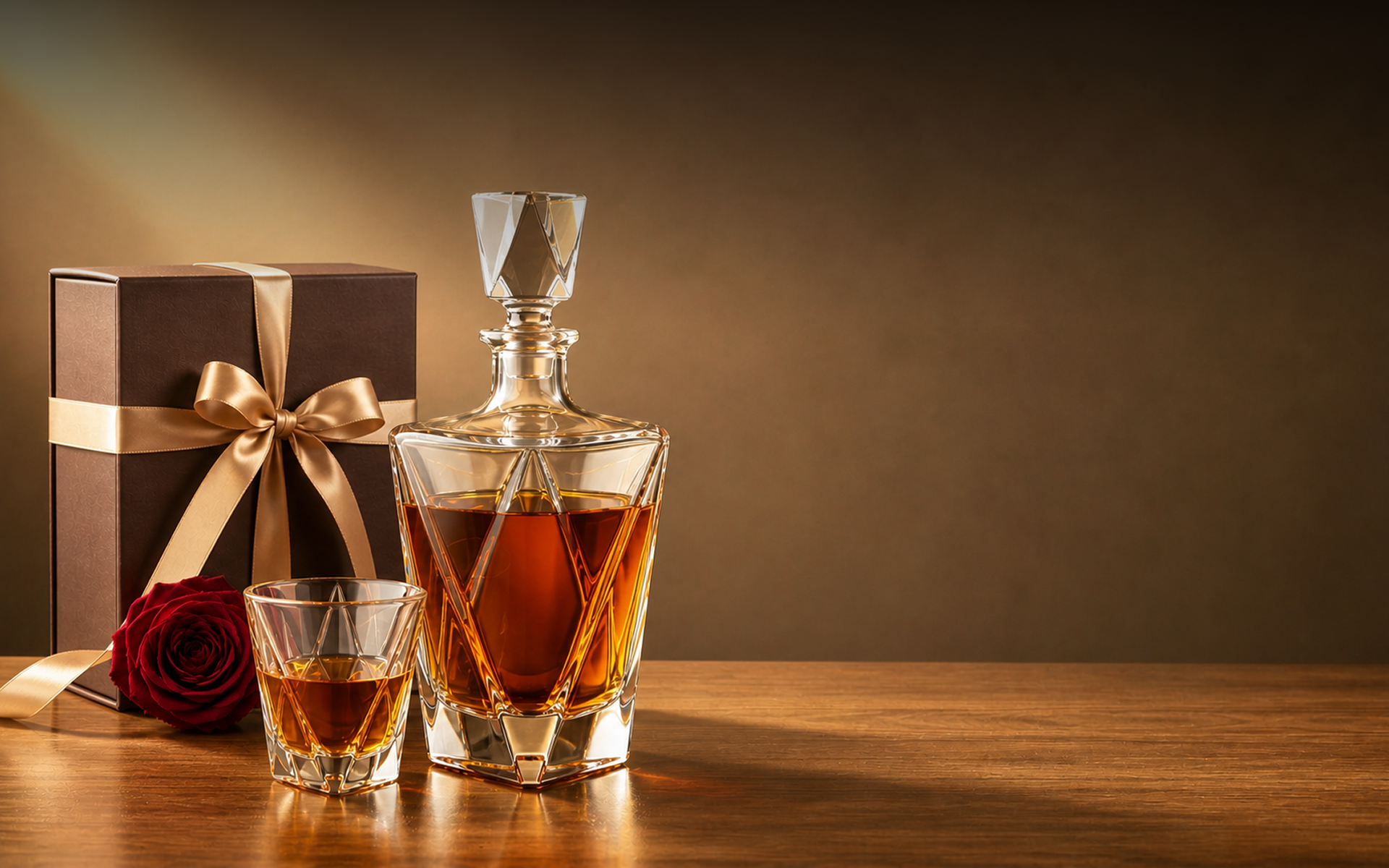
Why this matters: A personalized decanter set communicates something no original bottle ever could. It marks an occasion, honors a relationship, and signals a level of thought that a gift card or generic bottle never achieves. An engraved set becomes a piece that sits on a home bar for years and gets pulled out on meaningful occasions, not just used once and forgotten.
In almost every gift-focused order we process, the buyer is not choosing between a decanter and a bottle. They are choosing a decanter because no other gift says the same thing. The boss who built a career. The dad who deserves something beyond a tie. The grandfather whose name should be etched into something that will outlast the occasion.
The Boss Who Inspires Us All Engraved Decanter Set, the Best Dad Ever Engraved Decanter Set, and the Grandpa the Legend Luxury Engraved Set are designed with this in mind. They are gifts that pair with a bottle of the recipient's favorite whiskey and create a complete, meaningful experience. See the full guide to whiskey gifts for men for more ideas around building a gift that actually lands.
How to check right now: If you are shopping for a whiskey lover and wondering whether to give a bottle or a decanter set, consider whether the recipient has a home bar they display things on. If yes, an engraved decanter set will be pulled out and shown to guests for years. A bottle, however good, will be consumed and forgotten. The set wins on lasting impact.
The Hydro Gizmos approach: Every engraved decanter set from Hydro Gizmos ships ready to gift, with packaging and presentation that makes the unboxing part of the experience. Pair any set with the large ice cube trays from the accessories collection for a complete bar gift that covers every element of the serving experience.
The Decision You Actually Need to Make
If you are storing whiskey for more than six weeks, the original bottle is your best option. Keep it upright, away from light and heat, with the cap seated tightly. That is the environment distillers designed for their spirit.
If you are serving soon, entertaining guests, or working with the last third of a bottle, a well-sealed lead-free decanter is the right choice. It elevates the experience, makes pouring more controlled, and in the case of a nearly empty original bottle, actually preserves the whiskey better than leaving it in a vessel that is mostly air.
If you are giving a gift, the storage question does not enter into it at all. An engraved decanter set is a statement piece that creates a permanent part of someone's home bar. Browse the full luxury decanter collection and the complete shop to find the right fit.
The whiskey decanter vs original bottle debate is not actually a debate once you apply the right framework. Both have a role. The key is knowing which role applies to your specific situation.
Frequently Asked Questions
How do I know if my whiskey has been damaged by decanter storage?
You can identify oxidation damage by nosing the whiskey carefully before pouring. A whiskey that has been over-exposed to air through a poorly sealed decanter will smell muted, flat, or faintly papery compared to how it smelled when first opened. The fruity, floral ester notes will be among the first to fade.
If the whiskey smells significantly less complex or bright than you remember from earlier in the bottle, oxidation through inadequate sealing is the most likely cause. This process is gradual and does not make the whiskey unsafe to drink, but it does degrade the quality of the experience.
What does proper whiskey decanter storage look like in practice?
Proper whiskey decanter storage means using a lead-free glass vessel with a precision-ground, airtight stopper, filling it to at least 70 to 80 percent of its capacity to minimize headspace, and keeping it in a cool location away from direct sunlight and heat sources.
Do not display a filled decanter on a sunlit windowsill or near a radiator. The whiskey should be consumed within four to six weeks of transfer. If you are not going to finish it in that timeframe, transfer the remainder to a smaller sealed bottle rather than leaving it in a large, mostly empty decanter.
How often should I clean a whiskey decanter between uses?
You should rinse a whiskey decanter with warm water immediately after emptying it, before any residue dries on the interior.
A deep clean using warm water and a small amount of uncooked rice, shaken gently to scrub the interior walls, is recommended whenever you switch between different whiskey expressions.
Do not use soap, as detergent residue clings to glass and will introduce off-flavors into the next pour. Dry the decanter fully before refilling it, as moisture inside the vessel can dilute and subtly alter the whiskey's proof and flavor profile.
How much does a quality whiskey decanter set cost and is it worth the investment?
A quality lead-free whiskey decanter set with matching glasses typically ranges from roughly 40 to 150 dollars depending on design complexity, glass quality, and whether the set includes personalization or engraving.
For everyday home bar use and entertaining, a mid-range set in the 60 to 100 dollar range delivers all the functional and aesthetic benefits without the cost of hand-cut crystal. The investment is worth it if you entertain regularly, enjoy the ritual of a well-presented pour, or are looking for a gift that will be used and displayed for years.
It is not worth it if the whiskey will sit in the decanter untouched for months, in which case the original bottle is the better vessel and costs nothing.
What is the difference between lead crystal and lead-free glass in a whiskey decanter?
Lead crystal decanters contain up to 30 percent lead oxide, which is what gives them their exceptional weight, sparkle, and refractive brilliance. Lead-free glass decanters do not contain lead oxide and instead achieve their clarity through other mineral compositions.
For short-term serving, the lead content in leaded crystal poses negligible risk because the contact time is too brief for meaningful migration. For storage of whiskey over multiple weeks or months, lead-free glass is the safer and recommended choice, as prolonged contact between a high-alcohol spirit like whiskey and leaded crystal can allow trace lead to migrate into the liquid.
All Hydro Gizmos decanter sets are lead-free.
Whiskey decanter vs. wine decanter: can you use one for the other?
A whiskey decanter and a wine decanter serve different purposes and are not interchangeable for optimal use. Wine decanters are designed specifically to maximize surface area contact with air, featuring wide, flat bottoms and open tops with no stopper.
This intentional aeration helps soften tannins and release volatile aromas in red wine. A whiskey decanter, by contrast, has a stopper to minimize air contact, because whiskey does not benefit from the same degree of aeration and is more vulnerable to oxidation over time. Using a wine decanter for whiskey will accelerate flavor deterioration significantly.
Using a whiskey decanter for wine will limit the aeration that makes decanting wine worthwhile. They are purpose-built for different chemistry and should be used accordingly.
FREE WHISKEY DECANTER GUIDE
You have just diagnosed exactly how your whiskey should be stored and served. Now find the decanter set that matches the way you actually drink.
The Hydro Gizmos team has helped thousands of whiskey drinkers and gift buyers across North America find the right decanter for their bar, their budget, and their occasion.
Browse the Hydro Gizmos whiskey decanter collection and you will find:
-
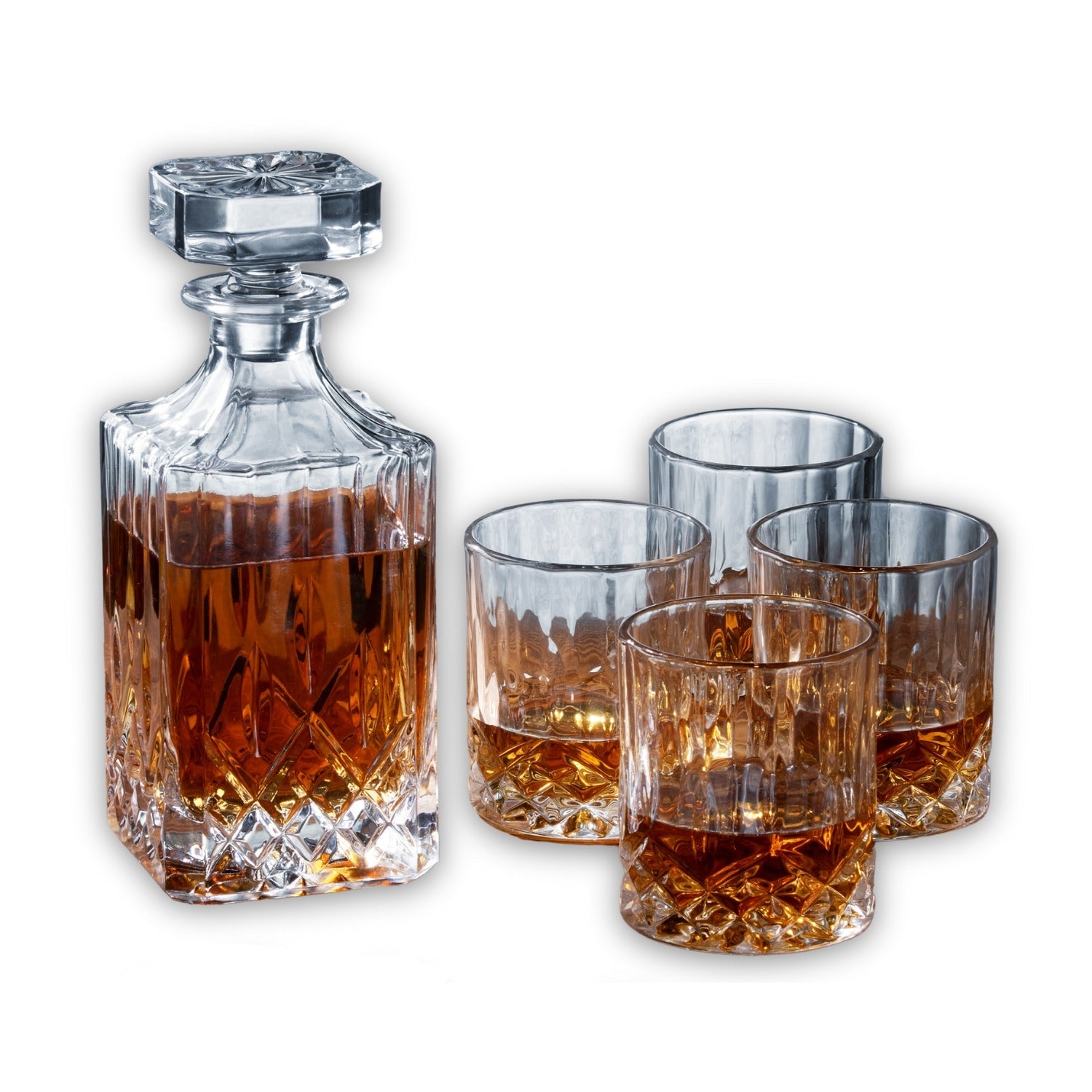
Lead-free glass decanter sets in globe, modern, twisted, and fashion styles, each with precision-ground stoppers tested for seal integrity
-
Luxury engraved and personalized sets for gifting, with presentation packaging included
-
Matching accessories including large-format ice cube molds designed specifically for whiskey glasses
-
Full buying guidance on the blog covering everything from decanter safety to flavor science, so you buy with confidence
Shop the Full Decanter Collection
Not ready to shop yet? Start with the complete guide to what makes a good whiskey decanter on the Hydro Gizmos blog.
Hydro Gizmos has been the choice of whiskey enthusiasts and thoughtful gift buyers looking for premium barware that performs as well as it looks.

Share:
Does a Whiskey Decanter Change the Taste? What Science Actually Says
How Long Can You Store Whiskey in a Decanter? The Honest Answer