
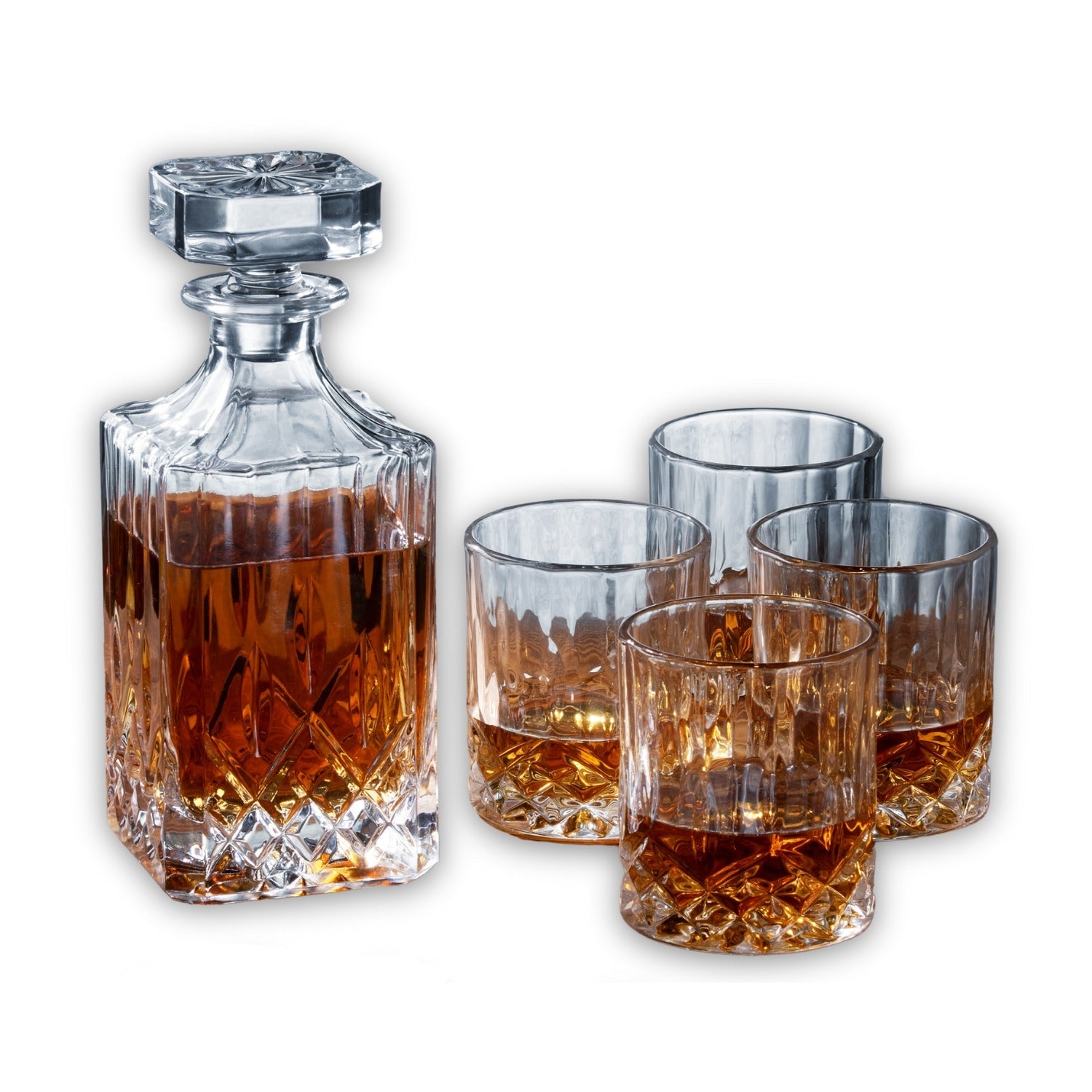
Most people pick a diamond cut crystal decanter because it looks impressive. That's a perfectly valid reason — but it's only half the story. The faceted geometry isn't decorative in the way a printed label or a coloured tint is decorative. It's structural. Every angled plane is doing optical work: refracting light, multiplying reflections, and — if the crystal is heavy enough — amplifying all of it into something that reads as expensive before a drop of whiskey has been poured.
What follows is a complete breakdown of why the diamond cut design works — the geometry, the material science, and the reason a poorly made version of the same pattern produces none of the same effect.
A diamond cut decanter uses precisely angled facets to refract and multiply light across its surface. The effect depends on both geometry and material: lead-free crystal with high clarity and real weight carries the pattern correctly. Machine-pressed designs lose the sharpness at the facet edges that makes the optical effect work. The design earns its place not just visually, but as a reliable quality signal — if the cut is crisp, the glass is almost certainly premium.
What does the diamond cut pattern actually do to light?
The diamond cut pattern creates a series of flat, angled facets across the outer surface of the glass. Each facet acts as a miniature prism: when light hits it, part of the beam reflects and part refracts, bending as it passes into the denser crystal material. The result is that a single ambient light source — a lamp, a window, a candle — becomes dozens of distinct light points across the decanter's surface.

This is the same optical principle that makes a cut gemstone look alive compared to a polished sphere. A sphere reflects one consistent image. A faceted surface breaks that image into components and sends them in different directions simultaneously. The decanter doesn't need to be lit from a specific angle — it responds to ambient light from any direction, which is why a diamond cut crystal decanter tends to look dramatically better on a bar shelf than a smooth-sided one placed under identical conditions.
The depth of that effect scales directly with the sharpness of the facet edges. A crisp, well-defined ridge between two flat planes creates a clean optical break — the light refraction is abrupt and high-contrast. A soft, slightly rounded edge (which is what happens with machine-pressing rather than hand-finishing) creates a gradual transition that diffuses the effect. The sparkle becomes a shimmer. The visual impact drops significantly.
Why does the material matter as much as the cut itself?
The optical performance of any cut-glass pattern is gated by the clarity and refractive index of the material it's cut into. Standard soda-lime glass — the kind used in budget decanters — has a refractive index of around 1.52.
The lead-free crystal formulations used in premium pieces, which replace lead with compounds like potassium oxide or barium oxide, typically achieve refractive indices of 1.56 to 1.60. That difference of 0.04 to 0.08 sounds small. In practice, it's the difference between a decanter that catches the light and one that holds it.
Higher refractive index means light bends more sharply when it enters the material, which means each facet produces a more intense, more defined reflection. The amber colour of the whiskey inside also plays into this: light entering through the facets picks up the liquid's colour as it passes through, adding warmth to the reflections on the exterior. This is why the same cut pattern looks fundamentally different — almost inert — when the decanter is empty versus when it's filled.
Weight is the secondary material signal. A diamond cut decanter that feels light in the hand is almost certainly thin-walled, which means the facets are shallow. Shallow facets don't produce the three-dimensional prismatic depth that makes the pattern work optically. The physical heft of a well-made crystal decanter — typically 1.5 to 2.5 pounds for a 750ml vessel — corresponds directly to wall thickness, and wall thickness corresponds directly to facet depth and edge definition. The weight isn't incidental. It's structural evidence of the cut quality.
How can you tell a hand-finished cut from a machine-pressed pattern?
The practical difference between hand-cut and machine-pressed diamond patterns becomes visible at close range and tangible on touch. Both processes can produce technically similar results on a product photograph which is why expectation gaps are so common in this category but the physical difference is immediate once you're holding the piece.
What to look for in person?
Run a fingertip across the ridge between two facets. On a hand-finished piece, the edge should feel sharp not dangerously so, but precise, like the corner of a well-made book. On a machine-pressed design, the same ridge is noticeably softer, sometimes almost rounded. The visual tell is the base: hand-cut crystal shows clean, flat facet planes that catch light uniformly across their surface. Machine-pressed designs often show slight curvature within each plane, and the light response is correspondingly less crisp.
A second test is the stopper. On a premium diamond cut crystal decanter, the stopper should be ground to fit the neck a process called lapping creating a near-hermetic seal through precision fit alone. Lift it out and it should come away with slight resistance, and seat back with a soft, solid click. A stopper that lifts freely, or that rattles slightly when the decanter is tilted, hasn't been lapped. That's a reliable sign that the hand-finishing claims on the product listing don't extend to the parts that matter functionally.
Does the diamond cut design affect function or just appearance?
The faceted exterior of a diamond cut decanter has no meaningful effect on the whiskey inside. Whiskey doesn't benefit from the aeration that wine decanters provide — the purpose of the vessel is display, ritual, and presentation rather than liquid chemistry. What the design does affect is the experience of using the object: a substantial, faceted decanter in hand changes the ritual of pouring. The grip is different from smooth glass. The weight distribution is different. The sound of the stopper seating is different.
These are not trivial differences. The premium decanter category is driven primarily by gifting — 60 to 70% of buyers are purchasing for someone else, according to Q1 2026 category research — and the core emotional job of a gift in this category is to signal that the giver chose deliberately.
A personalised diamond whiskey decanter set carries that signal clearly — the optical complexity, the weight, the quality of the seal — in a way that a smooth-sided, lighter alternative simply doesn't, even at the same price point.

The design also performs consistently across different settings. A globe or ship decanter reads as a specific aesthetic choice it appeals to a particular taste profile and can look out of place outside of it. The diamond cut pattern is neutral enough to belong on a minimalist bar shelf, a traditional home bar, or a corporate hospitality setting. It's the closest thing the decanter category has to a design that doesn't require the recipient to already want it.
What makes a diamond whiskey decanter set worth the price?
The price premium on a properly made diamond cut decanter set is justified by a stack of quality signals that are difficult to fake at the production level. Lead-free crystal formulation costs 40 to 60% more to produce than standard soda-lime glass, due to purer raw materials and extended annealing cycles. Hand-finishing the facet edges adds further production time. A precision-ground stopper requires individual fitting to each specific neck.
A set in the $65 to $95 range from a brand that specifies these features — verified lead-free certification, weight over 1.5 pounds for the decanter alone, glass-on-glass lapped stopper — is delivering material quality that budget alternatives at $20 to $35 structurally cannot. The unit economics don't allow it: at $20 retail, the landed cost per unit is around $5 to $8. At that price point, there is no budget for premium crystal, hand-finishing, or precision stoppers.
The matching glasses matter proportionally. Faceted rocks glasses that mirror the decanter's diamond pattern extend the optical effect to the full pour experience — the light play continues through to the moment the drink is in someone's hand. Pairing the set with quality whiskey accessories — oversized ice moulds in particular — completes the serving ritual without disrupting the aesthetic coherence the cut glass creates. The set is the unit of purchase, and the set is what the recipient displays together.
The cut is the credential
A diamond cut decanter earns its place because the geometry is honest. Unlike a printed pattern or a novelty shape, the quality of a cut is immediately legible — anyone who picks it up and runs a finger across the facets knows whether the edges are precise or approximate. That transparency is exactly what makes it the right design for a gift that's supposed to communicate genuine quality. You don't need to explain what makes it good. The object does that.
If the crystal is heavy, the cut is crisp, and the stopper seats cleanly, the diamond cut whiskey decanter set doesn't need to be introduced. It introduces itself.
Choose the set that doesn't need explaining.
The Hydro Gizmos diamond cut decanter set is lead-free crystal, weighted for presence, and sealed to stay that way.
→ Shop the Diamond Decanter Set


Share:
7 Whiskey Cocktails That Are Actually Worth Making (No Shaker Required)
The Best Whiskey Gifts for Men Aren’t Bottles — Here’s What Is